Top 5 Reasons Your Lawn Is Not Growing Properly: A Troubleshooting Guide to a Greener Yard
Introduction
There are few things more frustrating for a homeowner than pouring time, money, and physical effort into a lawn that simply refuses to thrive. You might spend your weekends mowing, watering, and hoping, only to gaze out at a landscape riddled with brown patches, thinning areas, and aggressive weeds. It is easy to feel defeated and assume you just don’t have a “green thumb,” but the reality is rarely that simple. Grass is a resilient plant, built to survive, but it requires a very specific set of conditions to truly flourish. When your lawn isn’t growing properly, it isn’t acting out of spite; it is communicating that one of its fundamental needs is not being met.
The difference between a struggling lawn and a neighborhood showstopper usually boils down to understanding the science of turfgrass management. It is rarely just one catastrophic event that ruins a lawn, but rather a consistent shortcoming in basic care routines. Often, homeowners are doing the right things but in the wrong amounts or at the wrong times. By shifting your perspective from merely “maintaining” the grass to actively cultivating the soil ecosystem, you can unlock significant growth. This article delves deep into the five most common, yet often overlooked, reasons your lawn is failing to perform, providing narrative, step-by-step solutions to help you diagnose and cure your ailing yard.
1. Improper Watering Habits
Water is life for your lawn, but the way most homeowners apply it is actually detrimental to long-term growth. The most common mistake in lawn care is frequent, shallow watering. It feels intuitive to give the grass a little sprinkle every day, especially when it is hot, to cool it off. However, this practice trains your grass roots to stay near the surface, waiting for their daily sip. When roots are shallow, they are incredibly vulnerable to intense heat and drought conditions.1 Furthermore, constantly wet surface soil encourages the growth of shallow-rooted weeds and creates a breeding ground for fungal diseases that can wipe out large sections of turf overnight.
The goal of proper irrigation is to train the roots to dive deep into the soil in search of moisture.2 To achieve this, you must adopt a “deep and infrequent” watering schedule. Instead of watering for fifteen minutes every day, you should aim to water heavily once or twice a week, depending on rainfall. You want to apply enough water to soak the soil to a depth of about six inches. This deep moisture forces the roots to grow downward, creating a robust, drought-resistant root system that can access water hidden deep in the ground long after the surface has dried out.3 A good rule of thumb is that your lawn needs about one to one and a half inches of water per week, either from rain or irrigation.
Timing is just as critical as volume when it comes to watering. The absolute best time to water your lawn is in the very early morning hours, roughly between 4:00 AM and 8:00 AM. Watering during this window serves two distinct purposes. First, temperatures are usually cooler and winds are calmer, meaning less water is lost to evaporation before it hits the soil. Second, and perhaps most importantly, it allows the grass blades to dry off completely as the sun rises. Watering in the evening is a recipe for disaster, as water sits on the grass blades overnight, creating a perfect, humid environment for destructive molds and fungus to take hold.4
Below is a visual representation of optimal irrigation practices, illustrating how deep watering affects root depth compared to shallow watering. An image showing a cross-section of soil revealing deep, healthy grass roots thriving due to deep irrigation, contrasted with shallow roots near a dry surface.

2. Mowing Mistakes
It is easy to view mowing merely as a chore to keep the grass short and tidy, but every cut is actually a stressful event for the plant. How you manage that stress determines whether your lawn thrives or declines. The most prevalent mowing mistake is “scalping,” or cutting the grass too short. Many homeowners believe shorter grass looks neater or that cutting it short means they won’t have to mow as often. Unfortunately, the green blade of the grass is where photosynthesis occurs—it is the plant’s food factory. By removing too much of the blade, you are starving the plant and significantly reducing its ability to generate energy for root growth. Short grass also exposes the soil directly to the sun, which dries it out faster and allows dormant weed seeds to germinate and take over.
To promote vigorous growth, you must adhere to the “one-third rule.” This golden rule of lawn care states that you should never remove more than one-third of the grass blade’s length in a single mowing session.5 If your grass has gotten too tall due to rain or a missed weekend, do not try to hack it all down at once. Instead, raise your mower deck to its highest setting for the first pass, then lower it gradually over subsequent days until you reach the desired height. For most common cool-season grasses like Kentucky Bluegrass or Fescue, a mowing height of three to four inches is ideal, especially during the heat of summer. Taller grass shades the soil, keeps roots cooler, and retains moisture much better than short turf.6
Beyond height, the condition of your mower blades plays a pivotal role in lawn health. A dull mower blade does not cut the grass cleanly; it tears and shreds the tips of the blades.7 These ragged, torn ends quickly turn brown, giving the entire lawn a dull, hazy cast regardless of how much you water it. More critically, these jagged wounds take longer to heal, leaving the grass plant open to disease pathogens and causing significant stress that halts growth. You should aim to sharpen your mower blades at least twice a season, or whenever you notice the tips of the grass looking frayed rather than cleanly sliced.
We have included a visual aid to help you identify the difference between a healthy cut and damaging tear on your grass blades. An image showing a side-by-side microscopic comparison of a clean, sharp grass cut versus a ragged, torn grass blade tip caused by a dull mower.
3. Poor Soil Foundation
If you have tried adjusting your watering and mowing with no success, the problem likely lies beneath the surface. You cannot grow a great house on a cracked foundation, and you cannot grow great grass on poor soil. Two primary soil issues stop lawns dead in their tracks: soil compaction and improper pH balance. Over time, foot traffic, heavy mowers, and even rainfall can compress the soil particles tightly together, squeezing out the air pockets that are essential for root survival.8 Compacted soil acts like a brick; roots cannot penetrate it to find nutrients, and water runs off the surface instead of soaking in. If you cannot easily push a screwdriver into your lawn, your soil is likely too compacted for healthy growth.
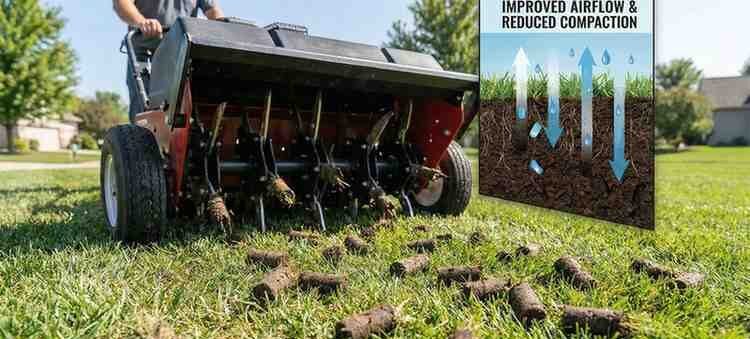
The solution to compaction is mechanical core aeration. This process involves using a machine to pull small plugs of soil out of the ground, depositing them on the surface. These holes literally let the soil “breathe,” immediately introducing oxygen to the root zone and creating channels for water and fertilizer to reach deep into the ground.9 Following aeration, the surrounding soil relaxes and fills the voids, relieving the compaction and allowing roots the freedom to expand.10 Aeration is best done during the lawn’s peak growing season—fall for cool-season grasses and late spring for warm-season grasses—so the turf can quickly recover from the temporary invasive procedure.
The second invisible soil issue is pH balance. Soil pH is a measure of acidity or alkalinity, measured on a scale of 0 to 14, with 7 being neutral.11 Most lawn grasses thrive in slightly acidic to neutral soil, roughly between a pH of 6.0 and 7.0.12 If your soil pH is too low (acidic) or too high (alkaline), essential nutrients like nitrogen, phosphorus, and potassium become chemically “locked up” in the soil. You could dump bags of expensive fertilizer on your lawn every month, but if the pH is wrong, the grass plant physically cannot absorb those nutrients. The only way to know your pH is through a soil test, available at most garden centers or through university extension offices. Based on the results, you would apply lime to raise pH in acidic soil, or sulfur to lower pH in alkaline soil, unlocking the nutrients for your grass to finally utilize.
4. Nutrient Deficiency
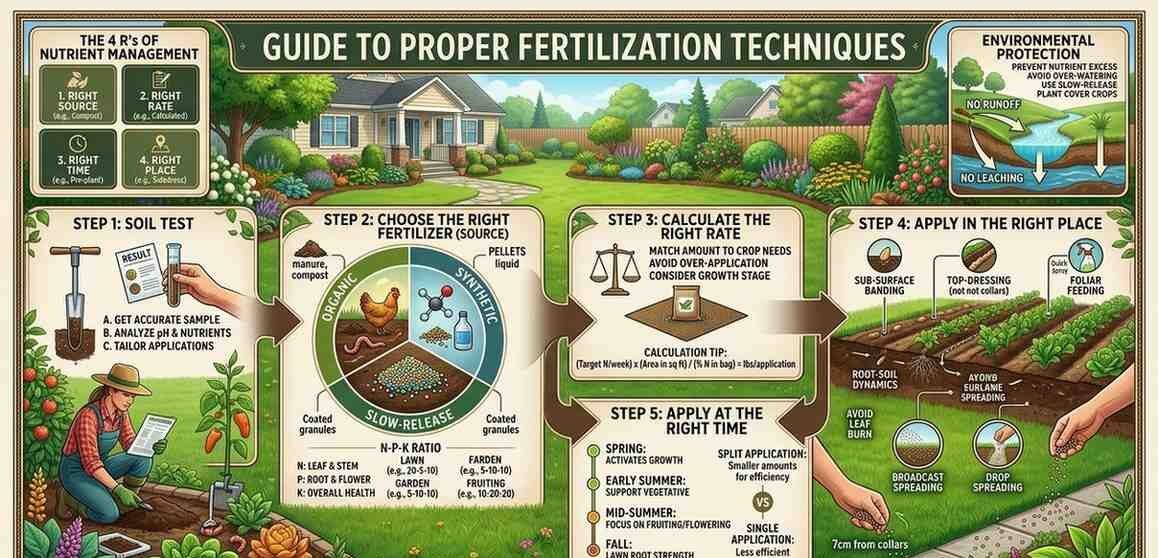
Just like any living organism, grass needs a balanced diet to grow. If your lawn is receiving sunlight and water but still looks pale yellow-green, grows slowly, or is thinning out, it is likely starving for nutrients. Grass is a heavy feeder, meaning it rapidly depletes the soil of the essential elements it needs to sustain thick, green growth. While healthy soil contains some trace minerals, a dense, manicured lawn requires supplemental feeding through fertilization to replenish what it uses. The three primary macronutrients needed are Nitrogen (N), Phosphorus (P), and Potassium (K), which you will see represented as three numbers on any fertilizer bag (e.g., 24-2-12).13
Understanding these numbers is key to fixing growth issues. Nitrogen is responsible for vibrant green color and rapid blade growth.14 If your lawn is pale, it needs nitrogen. Phosphorus is crucial for strong root development, which is vital for new grass or when recovering from damage.15 Potassium is the overall health booster, helping the grass withstand stress from heat, cold, drought, and foot traffic.16 A common mistake is using the wrong type of fertilizer at the wrong time, or worse, applying too much. Over-fertilizing, especially with high-nitrogen products during high heat, can chemically burn the grass, turning it crispy brown almost instantly.
The approach to feeding should be strategic rather than sporadic. For most lawns, a slow-release granular fertilizer is the best option. Unlike quick-release liquid fertilizers that give a sudden burst of growth followed by a crash, slow-release products break down over weeks, providing a steady, manageable supply of food that promotes sustained, uniform growth without shocking the plant.17 A typical schedule involves a feeding in the spring to jumpstart the season, perhaps a light feeding in early summer (being careful of heat), and highly important feedings in the fall to help the grass store energy for the winter and prepare for vigorous spring growth. Always use a spreader to ensure even coverage, as dumping fertilizer by hand will result in streaky, uneven growth and potential burn spots.18
5. The Hidden Threats
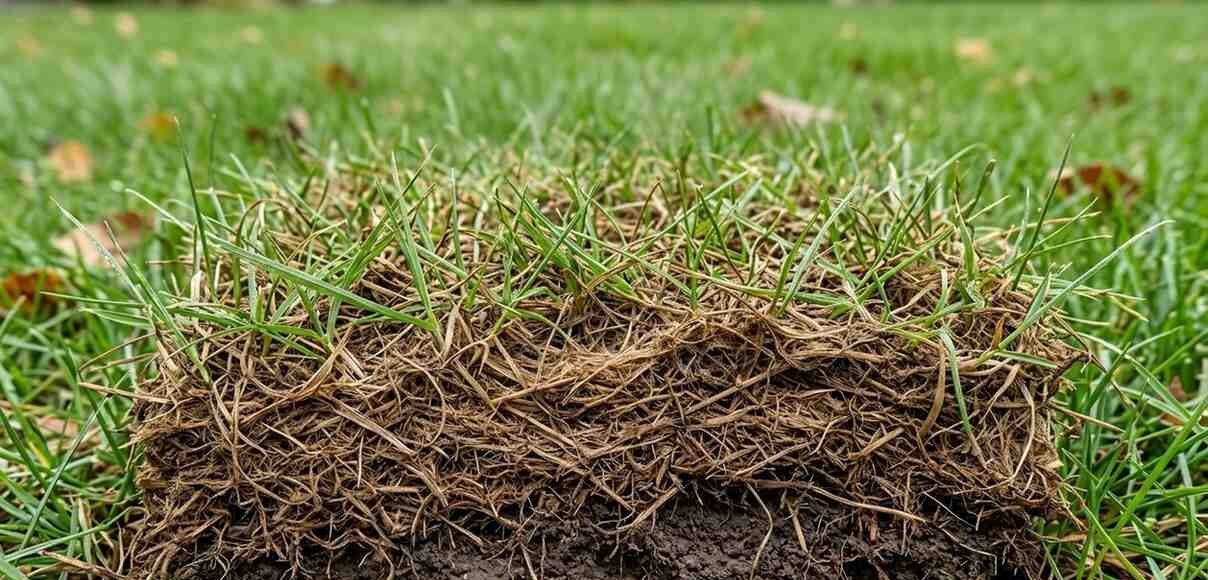
Sometimes, the reason for poor growth isn’t what you are failing to do, but rather an active external threat attacking your turf. These threats often go unnoticed until significant damage is done. The first common culprit is excessive thatch. Thatch is a layer of living and dead organic matter—stems, roots, and debris—that accumulates between the green grass blades and the soil surface.19 A little thatch (under half an inch) is healthy, acting as mulch to retain moisture.20 However, when thatch becomes too thick, over an inch deep, it forms an impenetrable barrier. It acts like a sponge, absorbing water before it reaches the soil, and it prevents air and fertilizer from reaching the roots. Grass growing in thick thatch is shallow-rooted and easily stressed.21 If your lawn feels spongy when you walk on it, you likely need to dethatch using a specialized rake or machine to tear out this choking layer.
Subsurface pests are another major reason for mysterious lawn decline, with white grubs being the most common offender in many regions. Grubs are the larvae of various beetles, and they feed voraciously on grass roots just below the surface.22 Because they sever the roots, the grass above ground cannot take up water and dies, appearing as irregular patches of brown turf that often show up in late summer or early fall. A tell-tale sign of a grub infestation is if skunks or raccoons are digging up your yard at night, as they are hunting the grubs.23 Another test is to tug on a section of brown grass; if it lifts up easily like a piece of loose carpet with no roots holding it down, you likely have a severe grub problem requiring a targeted insecticide treatment.
Finally, fungal diseases can wreak havoc on a lawn, often appearing as distinct rings, circles, or irregular patches of discolored or slimy grass. Disease outbreaks are almost always tied to environmental conditions, most commonly excessive moisture and humidity caused by improper watering habits (like evening watering) or poor air circulation. While fungicides exist to treat active outbreaks, the best cure is prevention through proper cultural practices. By watering deeply in the morning, mowing at the proper height, and ensuring your soil is aerated, you create an environment where grass thrives and fungus struggles to take hold.
Below is a visual guide to help you identify the layer known as thatch, which can suffocate your lawn if left unchecked.
Conclusion
Reviving a lawn that has stopped growing properly is rarely an overnight fix. It requires patience, observation, and a willingness to adjust your habits. By systematically addressing these top five areas—correcting your watering schedule to favor deep roots, adjusting your mowing height and keeping blades sharp, ensuring your soil foundation is breathable and balanced, providing adequate nutrition without overfeeding, and managing thatch and pests—you will resolve the underlying causes of poor growth. Remember that lawn care is a marathon, not a sprint. Nature takes time to heal, but once you align your care practices with the biological needs of the grass, you will be rewarded with a resilient, vibrantly growing lawn that is the envy of the neighborhood.