Suffolk Sheep Ewes: Genetics, Management, and Profitability
In the vast and competitive landscape of global agriculture, the choice of livestock genetics determines the difference between a struggling hobby farm and a thriving commercial enterprise. Among the hundreds of sheep breeds registered worldwide, one name stands as a titan of the meat industry: the Suffolk. While the rams are celebrated as the ultimate terminal sires, suffolk sheep ewes are the unsung heroines of high-output meat production. These robust, large-framed females provide the biological machinery necessary to birth, nurse, and wean some of the fastest-growing lambs in the animal kingdom.
To simply label the Suffolk as a “meat breed” is to overlook the complexity of the ewe’s role. She is a high-performance athlete, capable of converting forage and grain into muscle mass at an astonishing rate. However, this performance comes with a price: specific management needs, higher nutritional demands, and a requirement for skilled husbandry. This comprehensive guide serves as an owner’s manual for suffolk-sheep-ewes, exploring every facet of their history, biology, care, and economic potential.
Part 1: The Evolutionary History of the Suffolk Ewe
To understand the modern animal, we must look at the genetic roadmap that created her. The Suffolk breed was not an accident; it was a deliberate engineering project by English farmers in the late 18th century.
The Foundation Cross
The breed emerged in the Bury St. Edmunds area of Suffolk, England, resulting from the crossing of two distinct ancient breeds:
- Southdown Rams: Known for their excellent carcass quality and muscularity.
- Norfolk Horned Ewes: A hardy, wild, and rugged breed known for thriving in the harsh, dry conditions of East Anglia.
The goal was to combine the carcass quality of the Southdown with the hardiness and stamina of the Norfolk. The result was a black-faced, hornless (polled) sheep that grew faster than either of its parents. By 1810, the breed was recognized as “Suffolk,” and the first breed society was formed in 1886.
The Migration to America
When Suffolks arrived in the United States in 1888, the trajectory of the breed split. While the British focused on a functional, moderate-sized animal, American breeders began selecting for extreme size and height. Today, the “American Suffolk” is often taller and leggier than its British counterpart. This distinction is crucial for buyers of suffolk-sheep-ewes; are you buying the taller, show-ring style American genetics, or the deeper, thicker British style? Both serve different purposes in crossbreeding programs.
Part 2: Anatomical and Phenotypic Characteristics
Identifying a quality Suffolk ewe requires a trained eye. They are distinct from other black-faced breeds like the Hampshire or the Oxford.
The Head and Neck
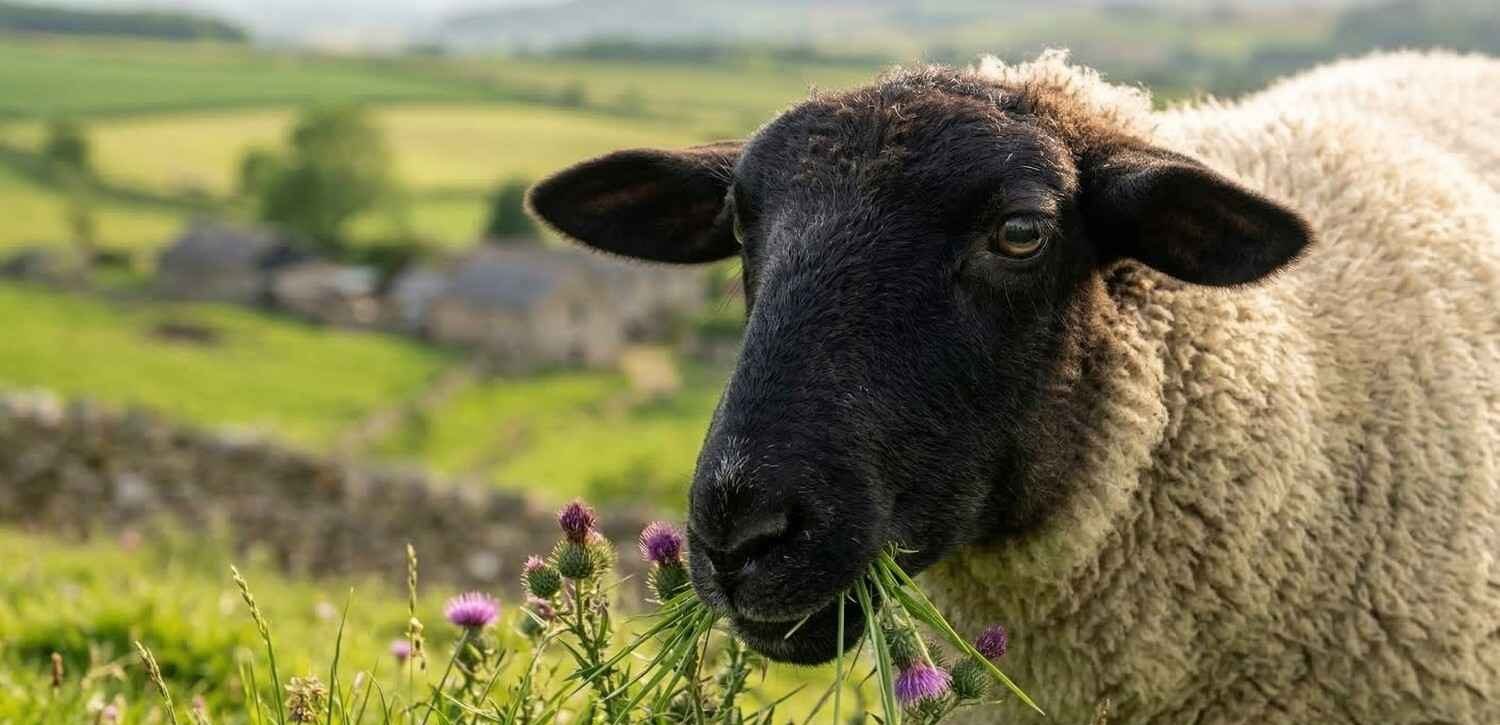
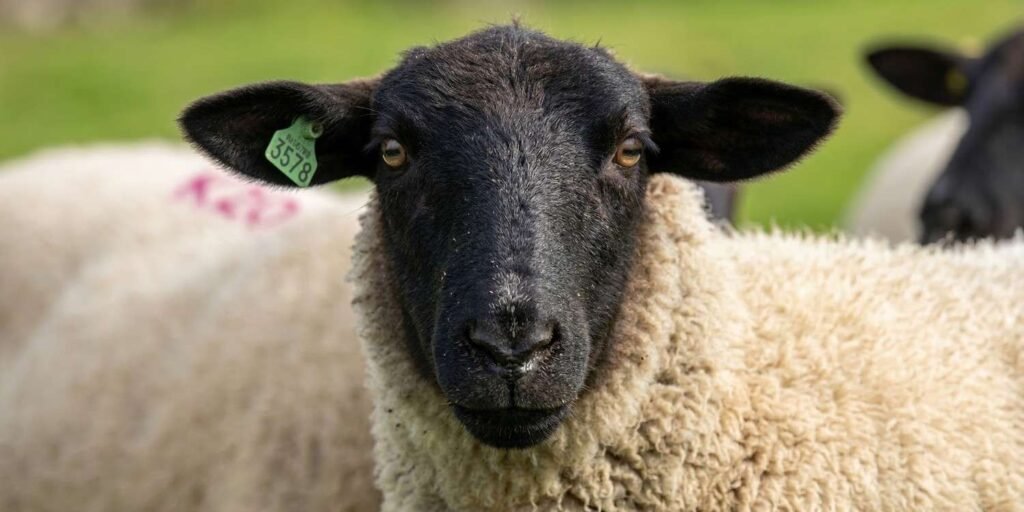
The most iconic feature is the head. It should be jet black and free of wool (clean-faced). Unlike the Hampshire, which has a wool cap, the Suffolk must be slick from the ears forward. The ears are long, bell-shaped, and droop slightly, giving the ewe a distinctive silhouette. The neck should be of moderate length but thick at the base, blending smoothly into the shoulders. A “ewe neck” (thin, weak neck) is a fault, as it often correlates with a lack of muscling in the body.
Body Capacity and Frame
Suffolk-sheep-ewes are among the largest of the sheep breeds.
- Weight: A mature ewe in good condition will weigh between 180 and 250 lbs (80 to 115 kg), though some show-line ewes can exceed 300 lbs.
- Height: They are tall, ensuring their udders are well off the ground, which helps prevent damage in rough terrain.
- The Carcass: The back should be long and level. The loin—the area producing the most expensive cuts of meat—must be wide and deep. When you run your hand over the spine of a Suffolk ewe, you should feel muscle, not bone.
Legs and Hooves
The legs should be black and free of wool below the knees and hocks. This “clean-legged” trait is a significant advantage in muddy environments, as it prevents mud balls (clags) from forming, which can weigh the animal down and encourage foot rot. The bone structure must be heavy enough to support their massive weight but not so coarse that it reduces the meat-to-bone ratio.
Part 3: The Ewe’s Job: Reproduction and Mothering Ability
This is the controversial aspect of the breed. For decades, critics have claimed that suffolk-sheep-ewes are poor mothers compared to white-faced maternal breeds (like the Polypay or Dorset). While there is nuance to this, modern Suffolks have improved significantly.
Prolificacy (Lambing Percentage)
Suffolk ewes are moderately prolific. They are not litter-bearing animals like the Romanov (which can have 4 or 5 lambs), but they are reliable twinners.
- Target Lambing Rate: A well-managed flock of Suffolk ewes should aim for a 160% to 180% lamb crop. This means for every 100 ewes, you wean 160-180 lambs.
- Seasonality: Suffolks are seasonal breeders. They are “short-day” breeders, meaning they typically cycle in the fall (August through December) to lamb in the spring. They are generally not suitable for out-of-season lambing programs (star-accelerated systems), unlike the Dorset or Merino.
Milking Ability
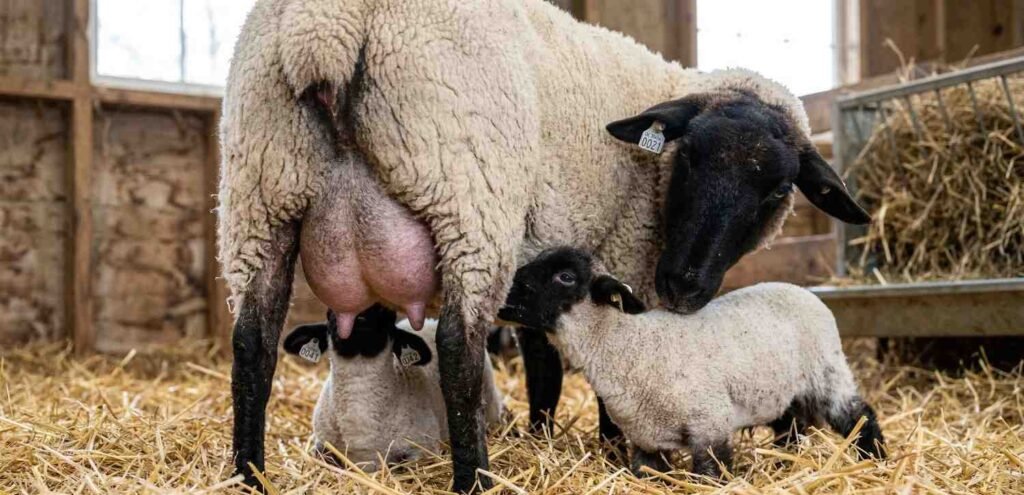
This is the Suffolk ewe’s superpower. She produces a high volume of milk that is incredibly rich in fat and protein. Because the breed is genetically programmed for rapid somatic growth, the ewe’s lactation curve is steep. She puts everything into the pail. This allows her to support two large lambs that can gain 0.7 to 1.0 lbs per day purely on milk and early forage.
Mothering Instincts
The criticism of “poor mothering” usually stems from two issues:
- Dystocia (Lambing difficulty): Because Suffolk lambs are born large (12-16 lbs), unassisted births can sometimes be difficult, leading to a tired ewe that may not bond immediately.
- Flightiness: Some lines of Suffolks can be high-strung. A nervous ewe is more likely to step on a lamb or pace the pen. Selection for temperament is vital. When buying suffolk-sheep-ewes, always ask to see the flock behavior. Do they run to the far fence, or do they approach the feed bucket calmly?
Part 4: Genetics and Crossbreeding Strategy
The magic of the sheep industry lies in heterosis (hybrid vigor). While purebred Suffolk flocks preserve the genetics, the commercial industry thrives on the crossbred ewe.
The “Suffolk Mule”
In the UK, a popular cross is the Suffolk ram on a North Country Mule ewe. The female offspring, known as Suffolk Mules, are highly sought after. They combine:
- From the Mule: Hardiness, mothering ability, and milkiness.
- From the Suffolk: Size, growth rate, and carcass conformation.These crossbred ewes make excellent commercial mothers that produce slaughter lambs with better grades than purebred maternal lines.
Terminal vs. Maternal Traits
If you are keeping a purebred flock, you must understand that you are primarily breeding for terminal traits (growth and meat). However, you cannot ignore maternal traits in your ewes, or you will have no lambs to sell.
- Selection Pressure: When selecting replacement ewes, do not just pick the biggest lamb. Pick the lamb born as a twin, raised as a twin, from a mother who never needed deworming and held her body condition. This balances the high-growth genetics with functional efficiency.
Genetic Defects to Watch For
Every breed has its kryptonite. For Suffolks, it is Spider Lamb Syndrome (SLS). This is a recessive genetic mutation that causes severe skeletal deformities. The lamb is born with abnormally long, spider-like legs and a twisted spine.
- The Fix: DNA testing. A genotype of “NN” means the animal is non-carrier. “NS” is a carrier. “SS” is affected. Never buy a Suffolk ram or ewe without knowing their Spider status. Modern breeders have largely eliminated this, but vigilance is required.
Part 5: Nutritional Management of the High-Performance Ewe
You cannot feed a Ferrari regular unleaded, and you cannot feed suffolk-sheep-ewes on scrub brush alone. Because of their large frame and high metabolic drive for growth, they have higher maintenance requirements than smaller breeds.
Phase 1: Maintenance (Post-Weaning to Breeding)
After weaning, the ewe has a few months to recover. This is the time to dry her off and regain body condition. A Body Condition Score (BCS) of 3.0 (on a scale of 1-5) is the target. Moderate pasture is usually sufficient here.
Phase 2: Flushing (Pre-Breeding)
Two weeks before introducing the ram, you should “flush” the ewes. This involves moving them to high-quality pasture or supplementing with grain (0.5 to 1 lb per day). This sudden energy boost signals the ewe’s body that times are good, causing her to ovulate more eggs. This is the cheapest way to increase your lambing percentage.
Phase 3: Late Gestation (The Danger Zone)
The last 6 weeks of pregnancy are critical. 70% of fetal growth happens here. A Suffolk ewe carrying twins has a massive demand for energy, but the lambs are taking up space in her abdomen, compressing the rumen.
- The Risk: Pregnancy Toxemia (Ketosis). If she cannot physically eat enough hay to meet her energy needs, she will burn her own fat, releasing ketones that can kill her.
- The Solution: You must introduce energy-dense concentrates (grains/corn/soy) during this period. Do not rely solely on hay unless it is premium alfalfa.
Phase 4: Lactation
A Suffolk ewe at peak lactation is working harder than a racehorse. She requires high levels of protein (16-18%) and constant access to clean water. If you underfeed her here, she will “milk off her back,” losing severe weight, or her milk supply will crash, stunting the lambs.
Part 6: Health Challenges and Solutions
Being a “down breed” (originating from the Downs of England), suffolk-sheep-ewes are susceptible to specific health issues that hill breeds might resist better.
Foot Health
Suffolks are heavy animals. A 250lb ewe puts immense pressure on her hooves. They are prone to foot rot and foot scald if kept in wet, muddy conditions.
- Management: Regular hoof trimming (at least twice a year) and foot baths (zinc sulfate) are mandatory management practices. If you live in a swampy area, the Suffolk might not be your best choice.
Parasite Resistance
Unlike the parasite-resistant St. Croix or Katahdin, the Suffolk has moderate to low natural resistance to the Barber Pole Worm (Haemonchus contortus).
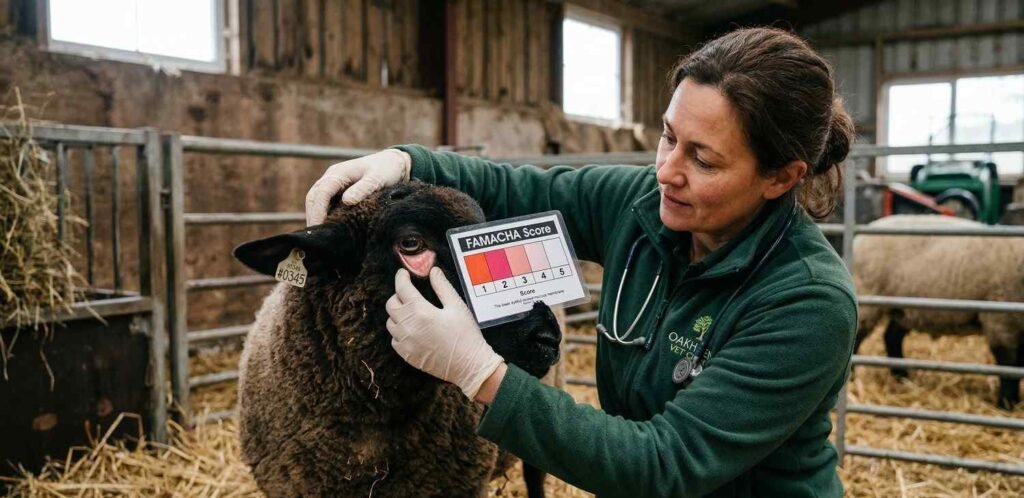
- FAMACHA Scoring: You must monitor the color of their eyelids (anemia indicator) regularly during summer.
- Pasture Rotation: Rotating pastures every 3-5 days breaks the worm life cycle and is far more effective than relying on chemical dewormers, to which worms are developing resistance.
Scrapie Susceptibility
Genetics play a huge role in susceptibility.
- Codon 171: This gene determines resistance.
- RR: Highly resistant (The Gold Standard).
- QR: Carrier but generally resistant.
- QQ: Highly susceptible.
- Advice: Only buy suffolk-sheep-ewes that are QR or RR. Avoid QQ ewes to future-proof your flock against this devastating disease.
Part 7: Wool Production and Shearing
While Suffolks are meat sheep, they do produce wool. The wool is classified as “medium wool.”
- Micron Count: 25 to 33 microns.
- Staple Length: 2 to 3.5 inches.
- Characteristics: It is spongy and elastic but contains black fibers from the face and legs.
- Market Value: The black fibers contaminate the white wool, making it unsuitable for dyeing into pastel colors. Therefore, Suffolk wool generally sells for a lower price, often used for blankets, batting, or insulation.
- Shearing: Ewes must be shorn annually, usually in spring before lambing. “Crutching” (shaving the rear end and udder area) is recommended 4 weeks before lambing to ensure cleanliness and help the lambs find the teats.
Part 8: The Economics of Owning Suffolk Ewes
Is it profitable to raise suffolk-sheep-ewes? The answer lies in your business model.
The Cost of Entry
Purebred registered Suffolk ewes are an investment.
- Commercial Grade Ewe: $250 – $400.
- Registered Show Ewe: $600 – $1,500+.
- Elite Genetics: Can go for thousands at auction.
The Return on Investment (ROI)
The ROI from a Suffolk ewe comes from the weight of her lambs.
- Scenario: A commercial producer sells lambs by the pound. A Suffolk-cross lamb might reach the target market weight of 120 lbs in 4 to 5 months. A lighter breed might take 6 to 7 months to reach the same weight.
- Feed Efficiency: The Suffolk lamb gets to market faster, meaning you spend less money on feed, less labor, and expose the lamb to fewer days of predation risk. This “days to market” metric is where the Suffolk ewe pays for her keep.
Cull Ewe Value
When a Suffolk ewe reaches the end of her productive life (usually around 6-8 years), she still has value. Because she is a large heavy animal, her “cull value” (meat value) is significantly higher than a small Shetland or Cheviot ewe.
Part 9: Suffolk vs. The Competition
How does the Suffolk ewe stack up against her main rivals?
- Suffolk vs. Hampshire: Very similar. Hampshires have wool caps and are slightly thicker/shorter. Suffolks are cleaner, slightly taller, and often grow faster. Hampshires are sometimes touted as slightly hardier.
- Suffolk vs. Texel: The Texel is a muscle block, shorter and wider with a higher dressing percentage (more meat, less bone). However, Texels can have more lambing difficulties due to broad shoulders. Suffolks generally grow faster (taller/longer) while Texels finish heavier.
- Suffolk vs. Dorper: Dorpers are hair sheep (no shearing) and extremely hardy. They are smaller than Suffolks. If you want low maintenance, go Dorper. If you want maximum weight and size, go Suffolk.
Part 10: Future Trends and Modern Breeding
The Suffolk breed is not static. Breeders are currently shifting focus back to functionality.
- “Wether Sires”: A trend in the US show market focusing on extreme muscle and “cool” look (shag/hair on legs). This is controversial as it sometimes sacrifices structural correctness.
- Production Suffolks: A movement (like the National Sheep Improvement Program – NSIP) that focuses purely on data: Estimated Breeding Values (EBVs) for growth, loin depth, and maternal milk. These breeders don’t care about pretty heads; they care about spreadsheets.
- Bareness: There is a push to breed Suffolks that are naturally slicker, requiring less shearing of the belly and legs, moving slightly toward hair sheep characteristics to reduce labor costs.
Conclusion: The Heavyweight Champion
The suffolk-sheep-ewes are not for the faint of heart. They are large, hungry, and demanding animals that require active management. They are not the “plant it and forget it” breed of the sheep world. However, for the producer who is willing to manage nutrition, monitor health, and invest in good genetics, the Suffolk ewe is an unrivaled production unit.
She offers the fastest route to a finished carcass, the capacity to raise heavy twins, and the genetic dominance to improve any flock she enters. In an industry where weight is money, the Suffolk ewe remains the heavyweight champion, tipping the scales in favor of the farmer’s profit margin. Whether you are running a purebred stud or a commercial meat operation, the influence of the Suffolk ewe is the foundation upon which the modern lamb market is built.
Frequently Asked Questions (FAQ)
How long is the gestation period for a Suffolk ewe?
The gestation period is approximately 144 to 147 days (roughly 5 months). This is slightly shorter than some other breeds, consistent with their rapid development.
Can Suffolk ewes live on grass alone?
While they can survive on grass, a lactating Suffolk ewe or a growing lamb rarely reaches its full genetic potential on grass alone unless the pasture is of exceptional quality (legume-rich). Supplementary grain is usually required for optimal performance.
Are Suffolk ewes aggressive?
Generally, no. They are docile. However, due to their size, they can be pushy around feed buckets. A ewe with a newborn lamb can be defensive, which is a good trait, but caution is advised.
What is the lifespan of a Suffolk ewe?
The average productive life is 6 to 8 years. After this, teeth wear down (broken mouth), and udder quality may decline, leading to culling.