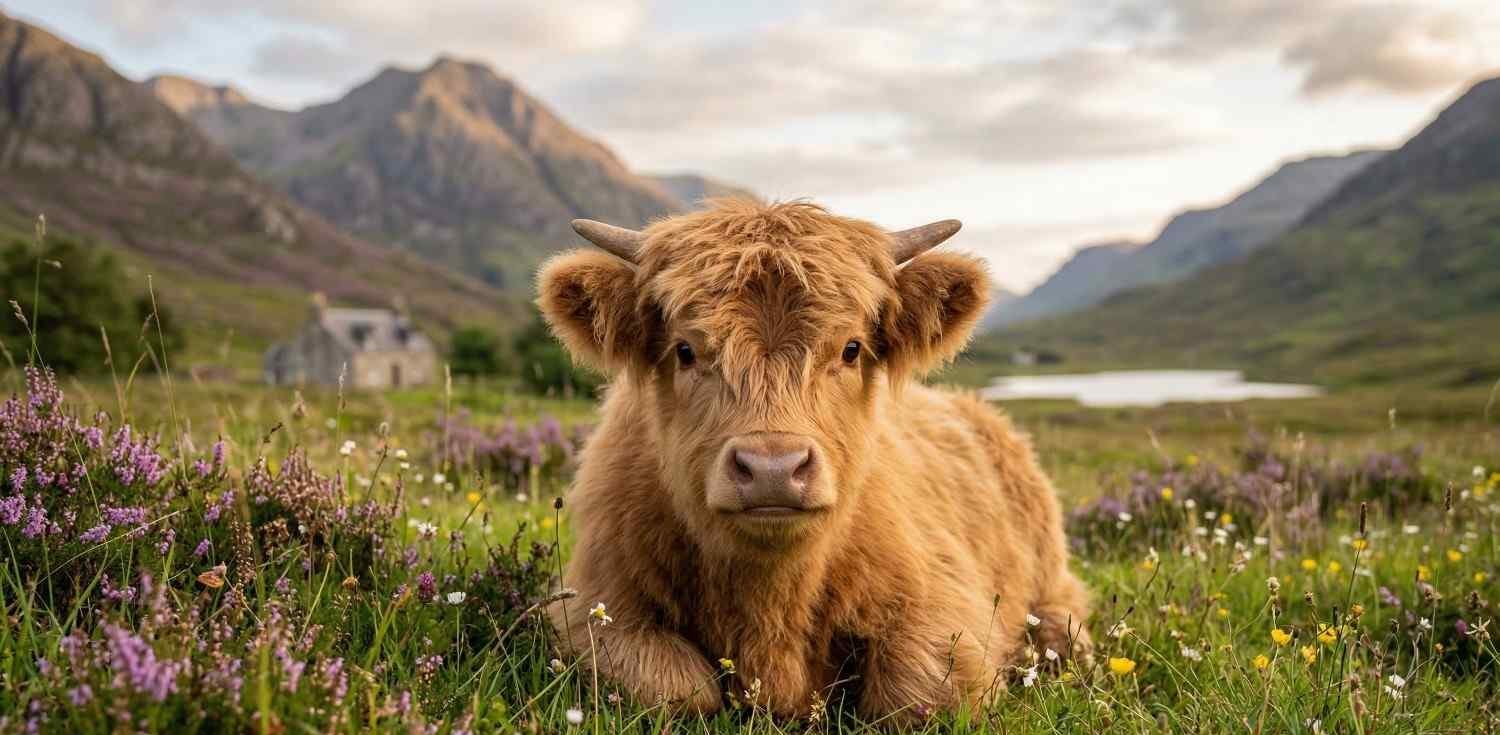
Mini Highland Cows: Care, Cost, and Characteristics
In the world of hobby farming and homesteading, few animals have caused a sensation quite like Mini Highland Cows. With their shaggy double coats, sweeping horns, and teddy-bear faces, they have transcended their status as livestock to become viral internet stars and beloved family pets. But beyond the adorable Instagram reels and Pinterest boards lies a real animal with specific biological needs, complex genetics, and significant care requirements.
If you are serious about bringing these miniature bovines to your property, a superficial overview is not enough. You need a deep dive. This comprehensive guide serves as an extensive manual for potential owners, covering the history, the science of their size, their temperament, detailed care instructions, and the financial reality of owning Mini Highland Cows.
1. The Origin Story: From the Scottish Highlands to Your Backyard
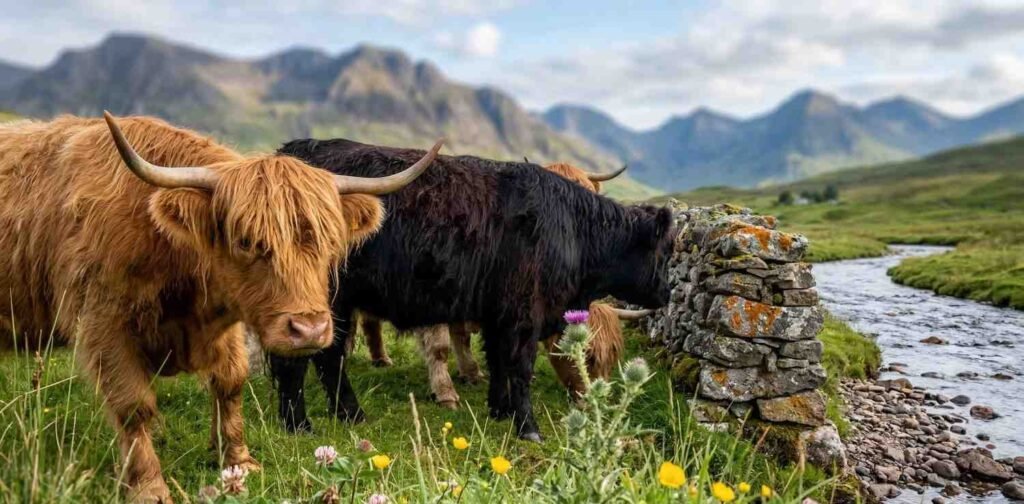
To understand the miniature version, one must first respect the history of the standard breed. The Highland cow (Heilan coo) is one of the oldest registered breeds of cattle in the world, originating from the rugged and rain-swept Highlands of Scotland.1
Historically, these cattle were bred to survive in some of the harshest conditions on earth. Their distinctive long hair is actually a double coat: an oily outer layer that sheds rain and snow, and a downy undercoat that provides warmth.2 This evolutionary trait makes them incredibly cold-hardy, allowing them to thrive where other breeds would perish.
Mini Highland Cows are not a separate species. They are the result of selective breeding of these ancient Scottish cattle. Over decades, breeders have either selected the smallest runts of the litter to breed together or introduced specific genes to reduce stature, aiming to create an animal that retains the hardiness of the Highland in a package that is easier to manage on small acreages.
2. Defining “Mini”: The Science of Size
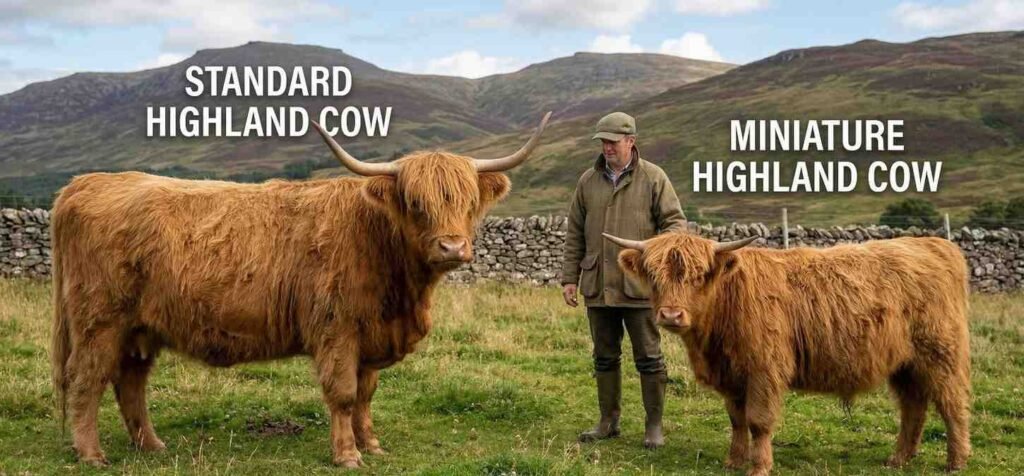
When researching Mini Highland Cows, you will encounter confusing terminology regarding their size. It is vital to understand that “Miniature” is a height classification, not a breed registration in the traditional sense (though specific registries do exist).
The Height Chart
Cattle are measured at the hip (the hook bone). The classifications generally break down as follows:
- Standard Highland: 48+ inches at the hip.
- Mid-Size Miniature (Mid-Mini): 42 to 48 inches at the hip.3
- True Miniature: 36 to 42 inches at the hip.
- Micro-Mini: Under 36 inches at the hip.
How is the Size Achieved?
There are two distinct ways breeders create Mini Highland Cows, and it is crucial to know which method was used for your potential animal.
- Selective Breeding (Non-Chondro): This is the “natural” way. Breeders take small standard cows and breed them with small standard bulls. Over many generations, the offspring become consistently smaller. These cows are generally perfectly proportioned, just smaller.
- Chondrodysplasia (Chondro Positive): This involves the “dwarfism” gene.4 In many cattle breeds, including Highlands (and often crossbred with Dexters), a gene mutation causes the long bones of the legs to be shorter. A “Chondro positive” cow will have a normal-sized body but significantly shorter legs. While this creates a very cute, low-to-the-ground look, it comes with genetic risks, specifically the “Bulldog gene” issue where breeding two carriers can result in non-viable pregnancies.
3. Physical Characteristics and “The Look”
What makes Mini Highland Cows so aesthetically pleasing? It is a combination of several unique physical traits.
The Coat
The coat is their crowning glory. It requires maintenance (which we will cover later), but it provides excellent protection.
- Summer Coat: They shed out their heavy undercoat in spring, looking much sleeker in summer.
- Winter Coat: In autumn, the fluff returns, giving them that iconic round, shaggy appearance.
Colors
While the classic ginger/red is the most famous, Mini Highland Cows come in a stunning array of colors:
- Red: The most common, ranging from deep mahogany to light orange.
- Black: A dominant gene color, making the cows look majestic and imposing.
- Dun: A beautiful grey-brown or mouse color.
- Yellow: Lighter than red, almost blonde.
- White: The rarest color, often associated with a recessive gene.
- Silver: A unique variation of dun with a silvery sheen.
- Brindle: Black tiger stripes over a red or brown base.
The Horns
Both male and female Highlands grow horns. In miniatures, the horns can still be quite large relative to their body size. They are used for scratching, knocking down brush, and establishing dominance within the herd.
4. Temperament: Are They Really “Pasture Puppies”?
Social media often portrays Mini Highland Cows as “pasture puppies,” suggesting they act exactly like Golden Retrievers. While they are famously docile, this anthropomorphism can be dangerous if not tempered with reality.
The Gentle Giant (in Miniature)
Highlands are renowned for their calm dispositions.5 They are generally not aggressive and are very intelligent. They quickly learn routines, respond to calls for food, and can be halter-trained with patience. They enjoy physical affection, particularly scratching on the neck, brisket, and behind the ears.
Herd Instincts
Despite their size, they are herd animals. A single Mini Highland Cow will be lonely, stressed, and potentially destructive. They need a companion—preferably another bovine, though some will bond with goats or donkeys (though this is less ideal due to dietary and behavioral differences).
Respecting the Horns
Even a “mini” cow can weigh 500 to 800 pounds. If they toss their head to shoo a fly and their horn hits you, it will cause injury. Owners must maintain a level of respect and awareness. They are not dogs; they are livestock with prey-animal instincts.
5. Detailed Care Guide: Housing and Environment
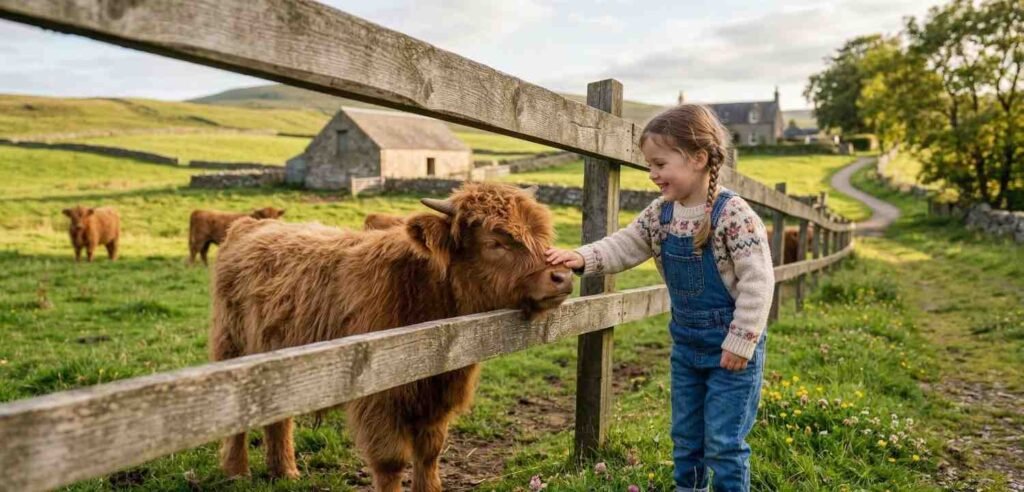
One of the primary benefits of Mini Highland Cows is that they require less land than standard cattle, but they cannot live in a suburban backyard.
Land Requirements
How much land do you need?
The general rule for standard cattle is 1.5 to 2 acres per cow. For Mini Highland Cows, you can often manage with 0.5 to 1 acre per cow, depending heavily on the quality of your pasture.
- High-Quality Pasture: If you have lush, green grass and practice rotational grazing, you can keep more animals on less land.
- Poor Quality/Dry Land: You will need significantly more acreage or be prepared to supplement heavily with hay year-round.
Fencing
Do not underestimate a mini cow’s ability to escape. They are known for rubbing against fences to scratch themselves, which can push down weak barriers.
- Recommendation: 4 to 5 strands of barbed wire or high-tensile woven wire (field fence) is standard. Electric fencing is also highly effective as a psychological barrier once they are trained to it.
- Height: Fencing does not need to be as high as for standard cattle, but it must be sturdy.
Shelter
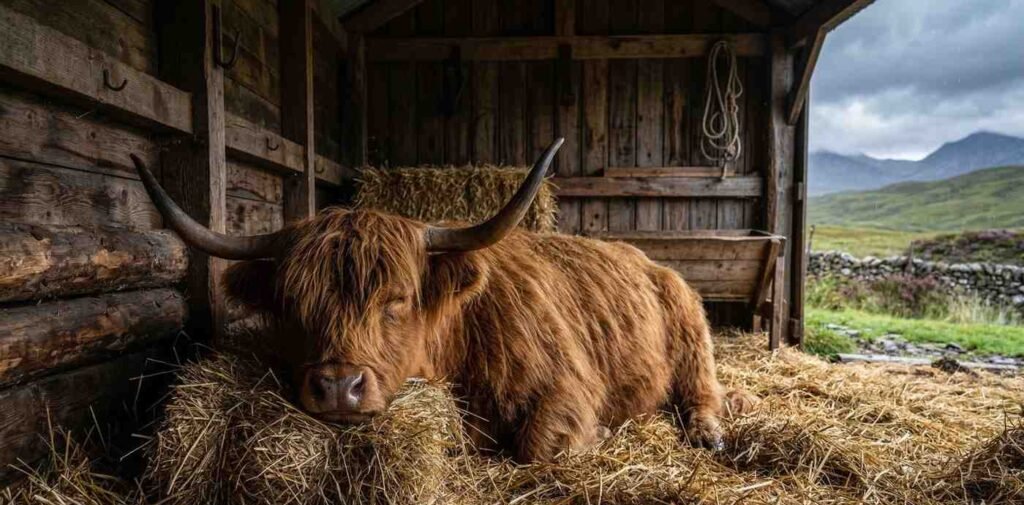
Because of their double coats, Mini Highland Cows are incredibly cold-tolerant.6 They do not typically require a heated barn. However, they must have protection from:
- Wind: A 3-sided run-in shed is usually sufficient.
- Rain/Wet Snow: While they tolerate cold, being wet and cold simultaneously can be hard on calves.
- Heat: This is the killer. Highlands struggle in heat. If you live in a hot climate (like Texas or Florida), you must provide deep shade, fans, or even misters. They are susceptible to heat stress.
6. Diet and Nutrition
Feeding Mini Highland Cows is relatively straightforward, but nutritional deficiencies can lead to poor coat quality and health issues.
Forage First
Their diet should consist primarily of grass (pasture) and hay.7 They are efficient converters of feed, meaning they can thrive on lower-quality forage that dairy cows would starve on.8
- Hay: In winter or during droughts, you must provide hay. A mini cow will eat approximately 2% to 3% of its body weight in hay daily.
Water
Fresh, clean water is non-negotiable. A lactating cow or a cow in summer heat can drink 10 to 20 gallons of water a day. Automatic waterers are preferred to ensure they never run dry.
Minerals
This is where many new owners fail. Cattle need loose minerals (not just salt blocks) to thrive. Local soil is often deficient in Selenium, Copper, or Magnesium.
- Copper Deficiency: This causes the coat to fade (black cows turn rusty red) and the hair to become brittle.
- Selenium: Vital for muscle development and calving.9
Treats
Yes, you can give them treats! They love apples, carrots, ranges, and range cubes (cattle cake). However, treats should be used for training, not as a main dietary staple to prevent obesity.
7. Grooming and Maintenance
Do Mini Highland Cows need to be brushed? If you want them to look like the fluffy teddy bears on Instagram, the answer is yes.
Brushing
Regular brushing serves three purposes:
- Bonding: It builds trust between you and the cow.
- Coat Health: It removes burrs, ticks, and matted hair.
- Shedding: In spring, they “blow” their coat. Helping them brush out the winter undercoat prevents matting and keeps them cooler.
Hoof Trimming
Unlike wild cattle that wear their hooves down on rocks, pasture cattle need hoof care. Mini Highland Cows typically require a hoof trim once or twice a year, depending on the terrain. You will need a tilt table or a professional hoof trimmer who can handle smaller livestock.
Pest Control
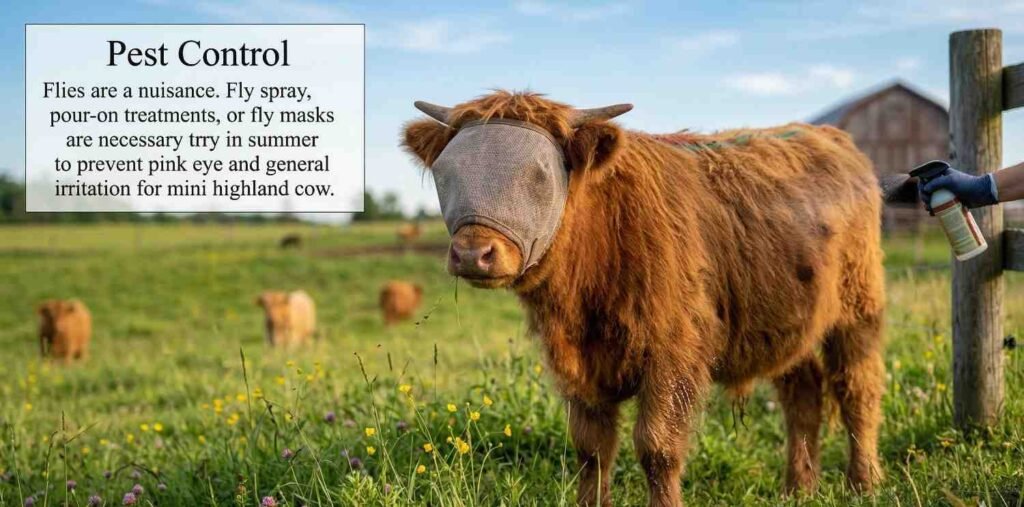
Flies are a nuisance. Fly spray, pour-on treatments, or fly masks are necessary in summer to prevent pink eye and general irritation.
8. Health: Common Issues to Watch For
While hardy, they are not immune to illness.
- Bloat: A life-threatening condition where gas gets trapped in the rumen, usually caused by eating too much lush clover or grain.
- Parasites: Internal worms can stunt growth. A rotational deworming schedule is essential.
- Heat Stress: As mentioned, panting, drooling, and lethargy in summer are signs they need immediate cooling.
9. The Financial Breakdown: Cost of Ownership
Mini Highland Cows are an investment.
Purchase Price
- Steers (Castrated Males): The cheapest option, usually $2,500 – $4,500. Perfect for pets.
- Heifers (Females): Breeding quality females range from $5,000 – $10,000+.
- Bull Calves: High-quality micro-mini bulls can fetch upwards of $10,000 – $15,000 depending on genetics and color.
Initial Setup Costs
- Fencing: $2,000 – $10,000 (depending on acreage and DIY vs. Pro).
- Shelter: $1,000 – $5,000.
- Trailer: You need a way to transport them to the vet (or a vet who makes house calls).
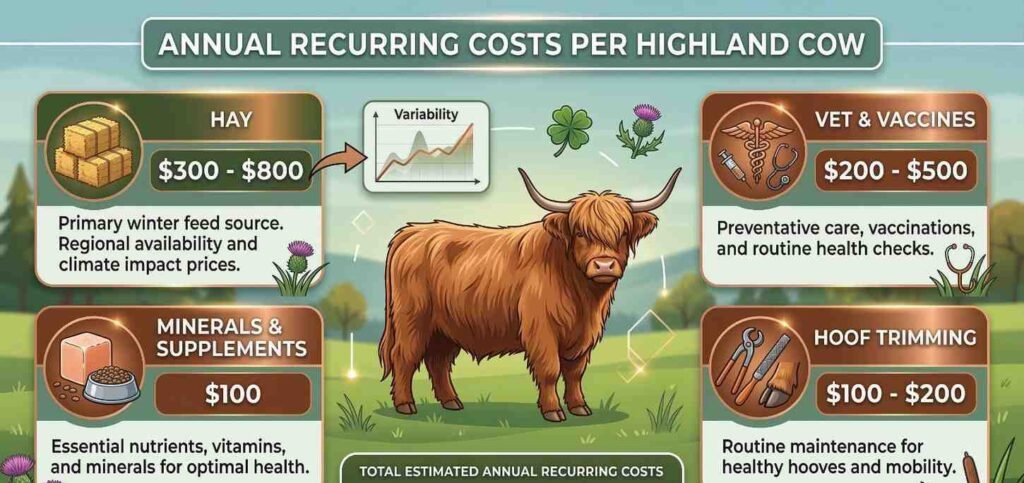
Annual Recurring Costs (Per Cow)
- Hay: $300 – $800 (highly variable by region).
- Vet/Vaccines: $200 – $500.
- Minerals/Supplements: $100.
- Hoof Trimming: $100 – $200.
Total Annual Estimate: Plan for $800 to $1,500 per year per cow in maintenance costs.
10. Breeding and Genetics: A Warning
If you plan to breed Mini Highland Cows, you must educate yourself on genetics.
The Bulldog Gene (Chondrodysplasia)
If you breed two Chondro-positive animals together, there is a 25% chance the calf will be a “Bulldog calf”—a severely deformed fetus that is usually aborted or dies shortly after birth. This is tragic and avoidable.
- Rule: Never breed Chondro to Chondro. Always test your animals’ DNA.
Assisted Calving
While standard Highlands are easy calvers, miniatures can sometimes struggle because the calf might be large relative to the mother’s smaller pelvis. You must be prepared to assist or call a vet during calving season.
11. Buying Guide: How to Avoid Scams
The popularity of Mini Highland Cows has given rise to scammers.
- The “Teacup” Scam: Scammers use photos of newborn calves and claim they are full-grown “teacup” cows. There is no such thing as a mature cow the size of a Golden Retriever.
- Deposit Fraud: Never send a deposit via “Friends and Family” methods to a breeder you haven’t verified.
- Verification: Always ask for a video call to see the cow in real-time. Ask to see the parents (this gives you the best indication of the calf’s future size).
12. Conclusion: Are Mini Highland Cows Right for You?
Owning Mini Highland Cows is a lifestyle choice. They are not lawn ornaments; they are living, breathing creatures that rely on you for their well-being. However, for those who are prepared for the mud, the cost, and the chores, they are incredibly rewarding.
They bring a sense of peace to a pasture that is hard to describe. They connect us to the land and to history, all while being undeniably adorable.
If you have the land, the budget, and the dedication, a Mini Highland might just be the best addition your family ever makes.
Frequently Asked Questions (FAQ)
Q: Can you keep a Mini Highland Cow in a house?
A: Absolutely not. They cannot be house-trained, they weigh hundreds of pounds, and they need to graze. They are farm animals, not house pets.
Q: How long do Mini Highland Cows live?
A: With good care, they can live into their late teens or early twenties (15-20 years).10
Q: Do they get along with dogs?
A: Generally, yes, if introduced properly. However, strange dogs chasing them can cause stress or injury.
Q: Can I milk a Mini Highland Cow?
A: Yes! Highland milk is very high in butterfat (up to 10%), making it delicious.11 However, the quantity will be much lower than a standard dairy cow, perhaps 1-2 gallons a day at peak.
Q: Are they noisy?
A: Generally, no. They are quiet animals that usually only moo when hungry, calling for a calf, or in heat.