
Illegal Falcon Trade: How Gulf Demand Fuels UK Bird Smuggling
The air inside the exhibition halls of Abu Dhabi’s International Hunting and Equestrian Exhibition is cool, scented with oud, and heavy with money. Under the unforgiving glare of stadium-style lighting, hundreds of raptors sit motionless on leather-bound perches. They are hooded, their eyes covered by ornate leather caps often stitched with gold or silver thread, designed to keep the predators calm in the unnatural bustle of the showroom.
To the uninitiated, this is a trade fair. To the connoisseur, it is a high-stakes stock market where the commodities have wings.
In a secluded glass-walled enclave marked “Elite Falcons Hall,” the atmosphere shifts from commerce to reverence. Here, amidst polished chrome and plush velvet seating, four young birds belonging to an undisclosed Emirati sheikh are displayed like the crown jewels. Access to this sanctum is strictly controlled; only those with the right connections—and the right bank balance—are permitted entry.
These are not merely birds; they are supreme status symbols. They possess Emirati passports to facilitate international jet-setting. They are treated in hospitals that rival the best private clinics for humans, staffed by European veterinarians specializing in avian medicine. The most prized among them do not travel in cages in the cargo hold, but on custom-fitted perches installed between the front seats of Bentleys and Range Rovers, staring out at the desert passing by at 100 miles per hour.
The price for such perfection? An American falcon at this very exhibition carries a price tag of AED 350,000 (£71,000). But for the right bird—specifically a wild-caught British peregrine—the price can be irrelevant.

For thousands of years, the relationship between the Bedouin and the falcon was one of mutual survival. In the harsh expanse of the Arabian desert, the falcon was a tool of the hunt, capturing meat for the tribe. It was a partnership born of necessity. Today, however, that necessity has been replaced by spectacle. In the modern UAE, falconry has evolved into a multimillion-dollar international industry, driven by “beauty contests” and high-speed races where the prize money is astronomical.
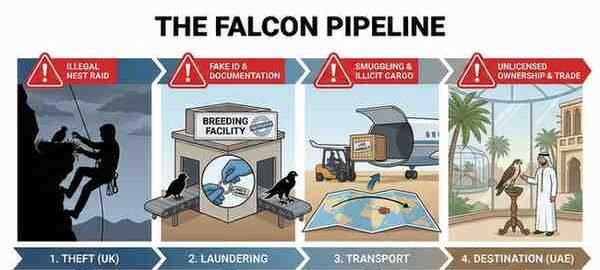
But an investigation by The Guardian and Arab Reporters for Investigative Journalism (ARIJ) has uncovered the dark cost of this luxury. Far from the air-conditioned palaces of the Gulf, a shadow industry is operating in the rain-soaked uplands of the United Kingdom. It is a criminal network of thieves, smugglers, and corrupt breeders who are systematically raiding the nests of British birds to feed the Gulf’s appetite for the “purest” racers on earth.
The Silent Vanishing
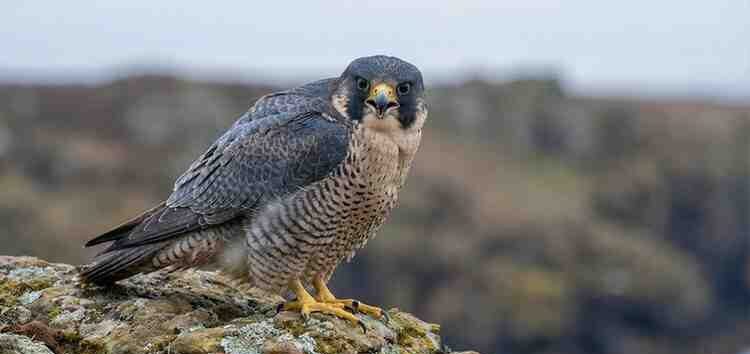
Three thousand miles away from Abu Dhabi, the landscape is starkly different. The windswept cliffs of Northern England and the rugged coasts of Scotland are the ancestral homes of the Peregrine Falcon (Falco peregrinus). These birds are the fastest animals on the planet, capable of diving at speeds of over 200 mph to strike their prey mid-air.
For decades, these cliffs were a sanctuary. Now, they are a crime scene.
Conservationists and police across the UK are reporting a disturbing, synchronized pattern. Peregrine falcon chicks are vanishing from remote ledges and treetop nests that are seemingly inaccessible. These are not opportunistic thefts by casual passersby. The nests are often located on sheer rock faces, reachable only by individuals with specialist climbing gear, intimate knowledge of the terrain, and the nerves to abseil down a cliff while under attack from screaming parent birds.
The scale of the theft is revealed in exclusive data shared with The Guardian and ARIJ by the Royal Society for the Protection of Birds (RSPB). Over the course of a decade—from 2014 to 2023—intelligence officers logged 126 separate incidents of nest raiding. Of these, 21 cases have been irrefutably confirmed using trail camera footage, DNA analysis, or eyewitness testimony.
These numbers, experts warn, are likely just the tip of the iceberg. For every nest raid caught on camera, dozens go undetected in the vast, unmonitored wilderness of the British Isles.
The Myth of Purity and the “Super-Bird”
Why British birds? Why go to the trouble of abseiling down a Scottish cliff when falcons can be legally bred in captivity?
The answer lies in a mix of biology and mythology that permeates the Gulf falconry scene.
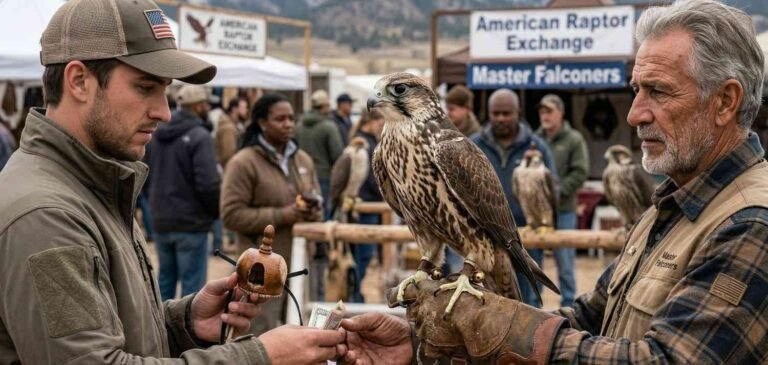
In the world of falcon racing, there is a persistent belief that wild-caught birds possess a “savage vigour” that captive-bred birds lack. Traders and owners at the Abu Dhabi exhibition speak openly of this preference, despite the fact that trading wild-caught peregrines is illegal under both UK law and international treaties.
“British falcons are in very high demand in the UAE because of their record in winning races, their purity of bloodline, and their speed,” explains an employee of a high-profile Emirati falconry organization, speaking on condition of anonymity.
There is also a biological basis for this preference, rooted in a scientific principle known as Bergmann’s Rule. This rule states that populations of a species found in colder climates tend to be larger and more robust than those in warmer climates. A peregrine falcon born on a freezing, gale-force cliff in the Scottish Highlands is perceived to be genetically tougher, larger, and faster than a bird bred in a climate-controlled aviary.
“Farm-bred falcons might come from mixed bloodlines,” the Emirati insider continues, “while wild-caught birds are pure and perform better.”
This sentiment was echoed by four separate farm owners and sellers, as well as two falconers interviewed on the floor of the Abu Dhabi exhibition. In a sport where a fraction of a second determines the winner of a luxury SUV or a cash prize, the perceived edge of a “pure” British wild bird drives a market frenzy.
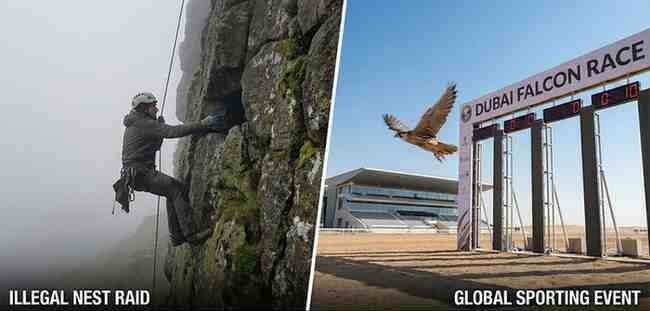
The demand has triggered a massive surge in exports. Last year, 4,000 peregrines or peregrine hybrids were exported from the UK to the Middle East. This year, police estimates suggest that number has risen to 5,000.
Data extracted from the Convention on International Trade in Endangered Species (CITES) database reveals that in 2023, 88% of all peregrine falcons exported from the UK were destined for the UAE. While many of these are legitimate captive-bred birds, authorities are now certain that the legal trade is being used as a cover to launder wild-caught chicks.
The Laundromat: How to Hide a Wild Bird
The mechanism of this illegal trade is sophisticated, relying on a method known as “wildlife laundering.”
To the casual observer, the UK falcon breeding industry appears to be booming legitimately. There are now approximately 160 breeding facilities in the UK, a staggering increase from just 27 in the 1980s. According to the NWCU, nearly all of these new facilities have financial or commercial links to the Middle East—either being owned directly by Gulf residents or having exclusive supply contracts with buyers in the region.
The primary legal export is the “Gyr-Peregrine” hybrid. This bird is a genetic cross between a Peregrine Falcon (for speed and agility) and a Gyrfalcon (the largest falcon species, prized for size and strength).
Here lies the catch: To breed these hybrids, facilities need purebred parents. Specifically, they need female peregrines. Because the female offspring of hybrids are often infertile, there is a constant, insatiable need for fresh, pure female peregrine stock.
This is where the wild birds are funneled.
A chick stolen from a nest in Scotland is transported to a breeding facility. There, it is fitted with a closed ring (a seamless metal band placed on the leg when the bird is a baby to prove it was captive-bred). If the ring is manipulated or fitted on an older bird, it is fraud. The bird is then issued paperwork claiming it is the offspring of two captive birds already at the facility.
Once the paperwork is stamped, the wild bird effectively ceases to exist. It has been “laundered” into a legal commodity, ready to be exported to Dubai or Abu Dhabi, or used as a “battery hen” to produce eggs for the hybrid market.
PC Gavin Ross, who has led the crackdown on falcon thieves, notes that science is finally catching up with the smugglers.
“Ross points to genetic evidence as the smoking gun, confirming that wild-caught birds are currently being hidden in breeding facilities across the nation. By comparing the genetic markers of suspicious birds against a database of wild samples collected by volunteers, police can now scientifically prove when a bird has no relation to its alleged “parents.”
However, enforcement is a game of whack-a-mole. The police simply do not have the manpower to inspect every facility. Yet, the statistics from the inspections they do conduct are damning.
“The findings are damning. Ross reveals that over half the centers targeted by police are breaking the law, with infractions escalating from simple paperwork mistakes to the ultimate crime: laundering wild birds for sale.”
In a recent sweep during 2023 and 2024, authorities conducted 27 physical inspections of peregrine breeding facilities—a significant ramp-up in activity. The result? 15 birds were discovered to be wild-caught, confirmed via DNA testing.
Denial and Defense
The findings of the NWCU and the RSPB have caused ripples of unease within the legitimate falconry community. Many industry leaders vehemently dispute the narrative that trafficking is widespread.
Dr. Nick Fox is the director of International Wildlife Consultants (UK) Ltd and a titan in the field who has supplied falcons to the royal families of the UAE and Bahrain. He argues that the illegal trade is negligible.
Julian Mühle, CEO of the International Association for Falconry and Conservation of Birds of Prey (IAF), takes a similar stance. He warns against painting the entire region with the brush of criminality.
“Comments gathered informally at an exhibition do not reflect the established preferences in the region,” Mühle asserts. He argues that the discovery of wild falcons in breeding facilities “should not be interpreted as evidence of widespread criminality.
Khaled Bin Soufan, a prominent falcon trader in the UAE, is even more categorical. “Zero,” he says, when asked about smuggling from the UK. “It is not allowed.”
Yet, the Abu Dhabi International Hunting and Equestrian Exhibition did not respond to requests for comment regarding the open discussion of illegal wild birds on their trading floor.
“Threatened by Greed”
The debate over numbers—whether it is dozens or hundreds—matters little to the peregrine falcon itself.
For the wild peregrine, life is a masterclass in aerial freedom. They spend their days soaring above cathedrals and coastlines, mastering the wind. For the trafficked bird, life shrinks to the size of a perch.
According to PC Ross, many of the wild birds kept in captivity for breeding will rarely, if ever, fly again. They are transformed into production units. “Some are treated like battery chickens,” he says, describing birds that are pumped full of supplements and forced to lay up to 14 eggs a season—far beyond their natural limit.
The tragedy is compounded by the history of the species. In the 1950s and 60s, the UK peregrine population crashed spectacularly due to the use of organochlorine pesticides like DDT, which caused their eggshells to thin and break. The species was on the brink of extinction in Britain and others countries.
Their recovery following the banning of DDT is hailed as one of the great conservation success stories of the 20th century. Today, there are approximately 1,750 breeding pairs in the wild. But that recovery is now being jeopardized not by chemicals, but by commerce.
For the volunteers who monitor the nests, the emotional toll is heavy.
George Smith has monitored 60 nests across a large area of south-east Scotland for nearly 40 years. He has watched generations of falcons fledge and take their first flights. He has also walked up to nests expecting to see chicks, only to find empty scrapes and human boot prints.
Smith estimates that in his patch alone this year, four nests containing at least 10 chicks were raided. Extrapolating that across the country, he believes the figure of 100 stolen birds annually is a conservative estimate.
He tries to maintain professional detachment, but it is becoming impossible. “It’s pretty bad just now,” he admits.
A Global Heritage at a Crossroads
The irony of the situation is profound. Falconry was added to the UNESCO Representative List on the Cultural Heritage of Humanity in the 2010. It is celebrated as a tradition that fosters a bond between human and nature.
Yet, as the investigation by the Guardian and ARIJ shows, the modern industrialization of this heritage is severing that bond. The demand for “elite” status symbols is stripping the British wilds of their apex predators, turning majestic creatures into commodities to be traded, wrapped in hoods, and placed in the passenger seats of luxury cars.

As the sun sets over the exhibition hall in Abu Dhabi, the deals are finalized. Money changes hands. Birds are moved into transport crates. Somewhere in Scotland, a volunteer checks a cliff ledge and finds it empty.
The pipeline remains open. And as long as the elite are willing to pay a premium for the “wild” spirit of British birds, the skies over the UK will continue to fall silent.
About this content:
This article was produced in collaboration between The Guardian and Arab Reporters for Investigative Journalism (ARIJ). It is part of the ‘Age of Extinction’ series, reporting on the catastrophic loss of species and what it means for humanity.