Crab Grass: Identification, Prevention, and Eradication
If there is one name that strikes fear into the heart of a lawn enthusiast, it is Crab grass. It is the ultimate opportunistic survivor. It doesn’t ask for much—just a tiny patch of bare soil and a little bit of sunlight—and within weeks, it can transform a manicured emerald lawn into a sprawling mess of tangled, coarse stems.
In this guide, we aren’t just looking at how to kill a weed; we are looking at how to win the long-term biological war for your backyard.
Quick Guide: The 2026 Crab Grass Battle Plan
- The Enemy: An annual weed that dies in winter but leaves behind thousands of seeds that germinate when soil hits 55°F in spring.
- The #1 Defense: Apply a pre-emergent herbicide when the Forsythia bushes bloom (usually mid-April in many zones).
- Cultural Control: Mow high (3.5+ inches) to shade the soil, and water deeply but infrequently to starve the shallow-rooted weed.
- Post-Emergence: If it’s already up, use herbicides containing Quinclorac before the plant gets too big.
- The Long Game: A thick, healthy lawn is the only permanent solution.
Know Thy Enemy – What is Crab Grass?
To defeat Crab grass, you must first understand what it is. Belonging to the genus Digitaria, this annual grass is a “C4” plant. This is a scientific way of saying it is exceptionally efficient at photosynthesis in high temperatures and low-moisture environments—the exact conditions that cause your “C3” (cool-season) lawn grasses to go dormant.
Why Is It Called “Crab” Grass?
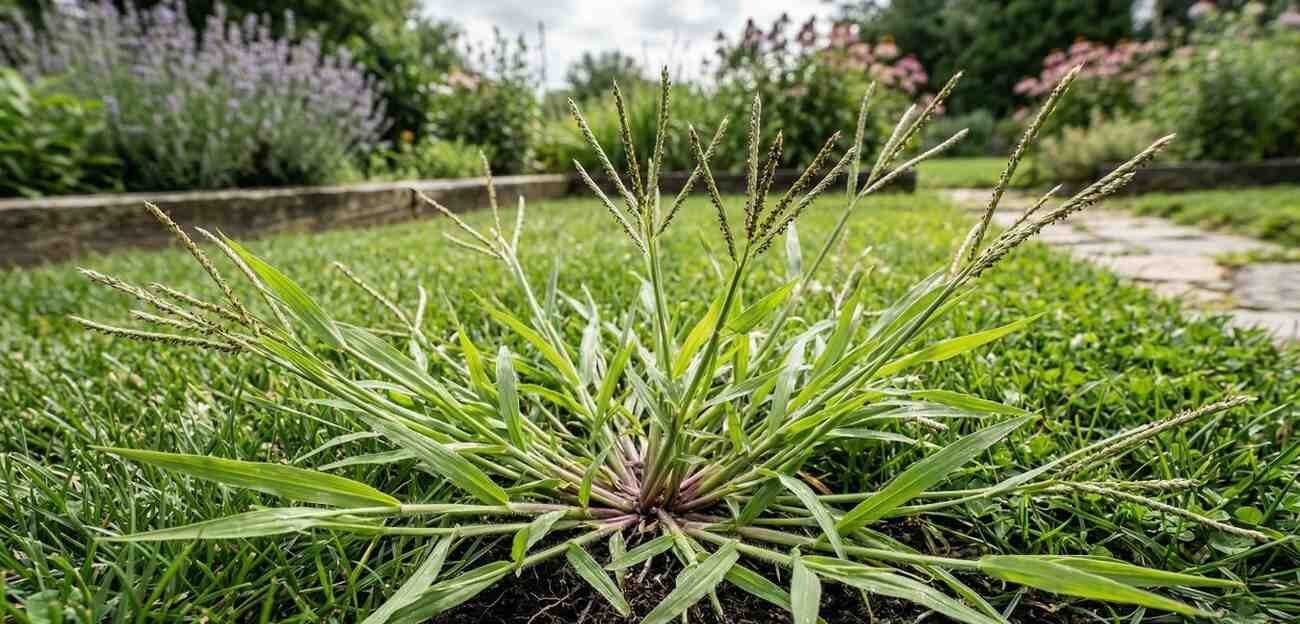
The name is literal. The stems grow outward from a central hub rather than upward, mimicking the legs of a crustacean. This sprawling habit allows a single plant to cover a massive surface area, smothering your desirable grass and hogging all the nutrients.
The Two Common Culprits
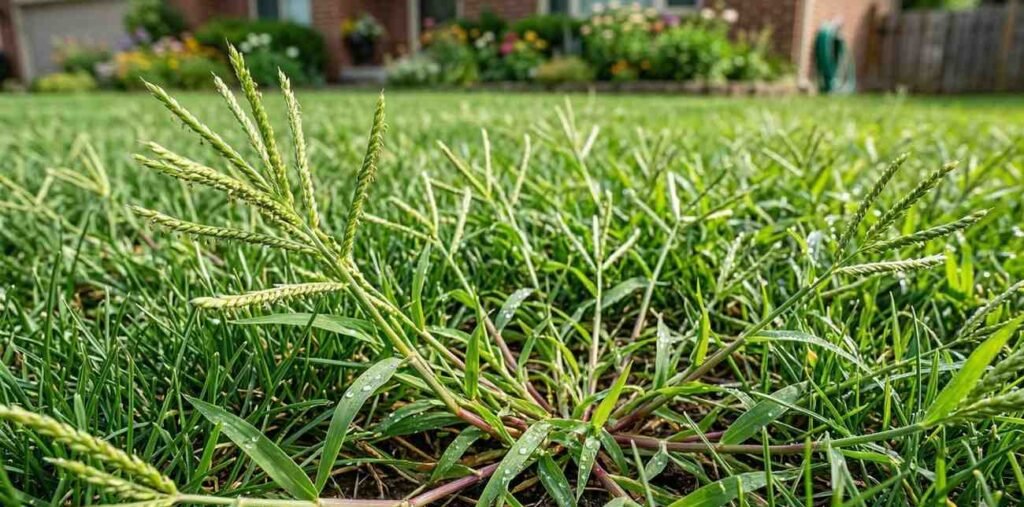
- Large Crabgrass (Digitaria sanguinalis): Notable for its hairy leaves and stems. It can grow quite tall if left unmowed.
- Smooth Crabgrass (Digitaria ischaemum): Usually smaller, hairless, and darker green. This is the one you’ll most likely see creeping into the edges of your driveway or sidewalk cracks.
The Biological Lifecycle (The 150,000 Seed Problem)
The most terrifying statistic about Crab grass is its reproductive capacity. A single healthy plant can produce up to 150,000 seeds in a single season. These seeds are then dispersed by wind, water, lawnmowers, and even your pets’ paws. It is crucial to interrupt this cycle.
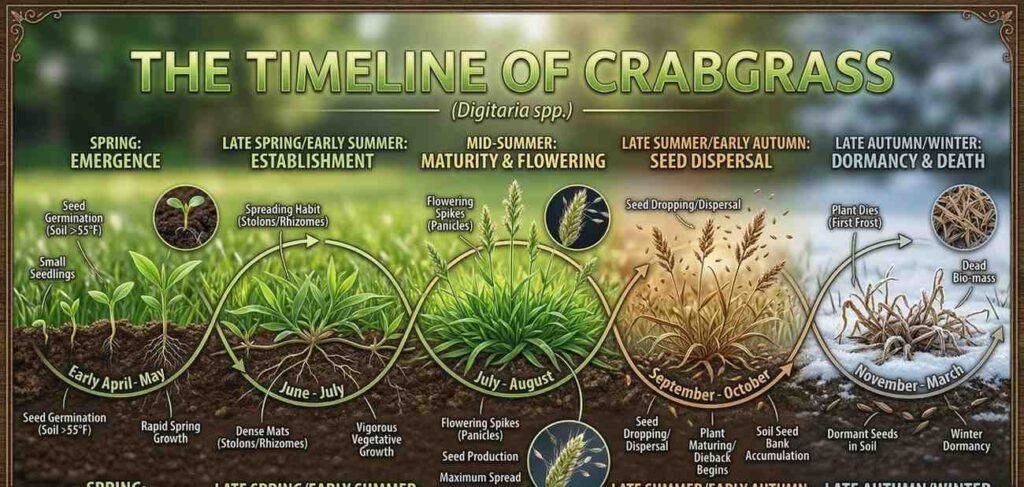
The Timeline of Invasion
- Winter (Dormancy): The parent plant dies with the first hard frost. Seeds sit in your soil, waiting.
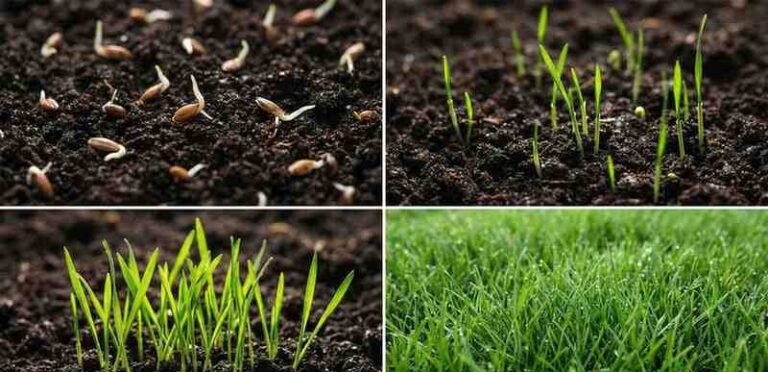
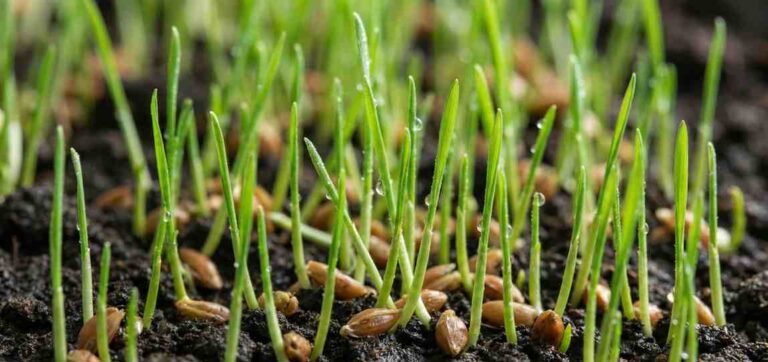
- Spring (Germination): When soil temperatures reach a consistent 55°F at a depth of 2 inches for three to five days, the seeds wake up.
- Summer (Growth): In the heat of mid-summer, while your Fescue or Bluegrass is struggling, the crabgrass enters its “tiller” stage, rapidly expanding its footprint.
- Late Summer/Fall (Seeding): The plant sends up seed heads (those three-pronged forks at the top of the stem) to drop next year’s army.
Identification – Is it Crab Grass or a Look-alike?
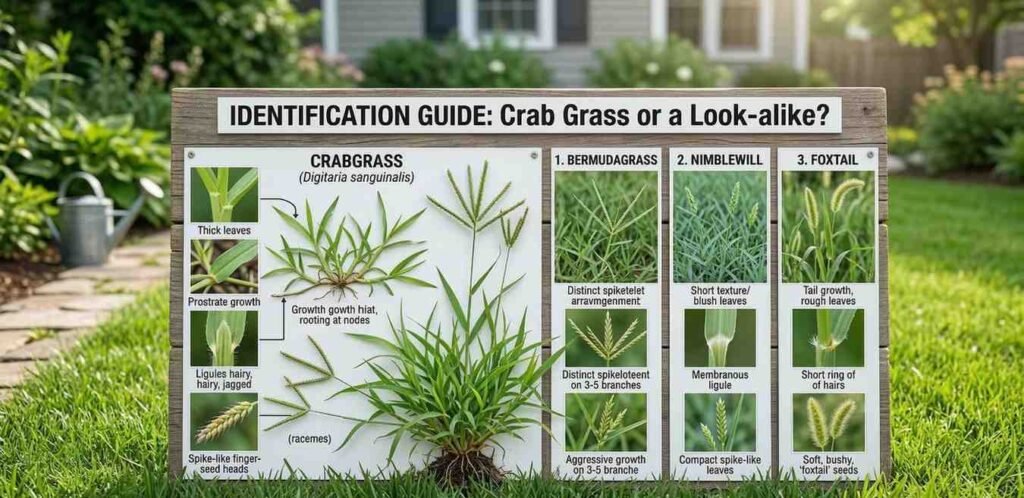
Many homeowners waste hundreds of dollars applying the wrong chemicals because they misidentify the weed. Before you spray, confirm the target.
Common Look-alikes
| Weed Name | Appearance Difference | How to Tell |
| Quackgrass | Long, underground “fingers” (rhizomes). | It has “auricles” (little clasping claws) right where the leaf blade meets the stem. |
| Tall Fescue (Clumping type) | Grows in clumps but is more upright. | The leaves have prominent vertical veins and feel “serrated” or rough on the edges if rubbed backward. |
| Goosegrass | Similar sprawling habit to crabgrass. | The center of the “crab” is distinctly white or silvery, and the stems are much tougher to break by hand. |
The Golden Rule of Pre-Emergence
The most effective way to manage Crab grass is to ensure it never sees the light of day. This is achieved through Pre-emergent Herbicides. These chemicals create a microscopic “vapor barrier” at the soil surface that kills the seedling as it tries to sprout.
The Forsythia Rule (Nature’s Indicator)
You don’t need a soil thermometer to know when to apply pre-emergent. Nature provides its own signal. When the Forsythia bushes (the ubiquitous bright yellow flowering shrubs) begin to drop their blooms and the Lilacs begin to bud, the soil is hitting that magic 55°F mark in your specific micro-climate.
Expert Tip: If you see dandelions in full bright yellow bloom, you might be a few days late, but you should still apply the treatment immediately to catch late germinators.
Application Best Practices
- Water it in: Most pre-emergents require 0.5 inches of water (rain or irrigation) within 48 hours to “activate” the barrier and wash it down to the soil level.
- No Aeration: Do not aerate your lawn after applying pre-emergent. You will punch holes in the chemical barrier, giving the seeds an “escape hatch.”
- The “Split” Application: For the best results in 2025, professional turf managers use a split application. Apply half the recommended dose in early April and the other half in late May. This extends the protection deep into the summer to fight late-season germination.
Cultural Control – Making Your Lawn a Fortress
Chemicals are a temporary fix. A healthy, thick lawn is the only permanent solution to Crab grass. Because crabgrass seeds need direct sunlight to germinate, a dense canopy of desirable grass will naturally suppress them.
Mowing for Success
Most homeowners mow their grass way too short in the spring. If you cut your lawn to 2 inches, you are inviting weeds.
- The 3.5-Inch Rule: Set your mower to its highest or second-highest setting. This creates deep shade on the soil surface, preventing crabgrass seeds from getting the light they need to wake up. It also promotes deeper roots for your good grass.
Watering Habits
Crabgrass has a shallow, opportunistic root system. If you water your lawn every day for 5 minutes, you are keeping the surface moist—perfect for weeds and terrible for grass.
- Deep and Infrequent: Water 1 inch per week in a single session (or two heavy sessions). This forces your “good” grass roots to grow deep into the soil to find moisture, down where the crabgrass cannot compete.
Post-Emergent Tactics – What to Do if They’ve Already Sprouted
If you missed the spring window and you see those tell-tale crab-like legs in your lawn in June or July, you need Post-emergent Herbicides.
The Ingredient to Look For: Quinclorac
Most standard big-box store “Weed-B-Gon” style sprays will kill dandelions but won’t touch crabgrass. You need a product that specifically lists Quinclorac as an active ingredient.
- Timing is Everything: Post-emergents work best on young plants (the “1–3 tiller” stage). Once the crabgrass gets huge, purplish, and starts producing seeds in August, chemicals become significantly less effective.
- Temperature Matters: Do not apply these chemicals when the air temperature is over 85°F. You risk “burning” and damaging your desirable Fescue or Bluegrass along with the weeds.
Organic and Natural Alternatives
In 2025, many homeowners are prioritizing sustainable practices. While organic methods require more patience and labor, they are better for soil biology.
Corn Gluten Meal
This is a byproduct of corn processing. It acts as a mild pre-emergent by drying out the root hairs of seeds as they try to sprout.
- The Catch: It is also about 10% nitrogen by weight, so it fertilizes the weeds that it doesn’t kill. Use this only if your lawn is already relatively thick and healthy.
The “Screwdriver” Method (Manual Removal)
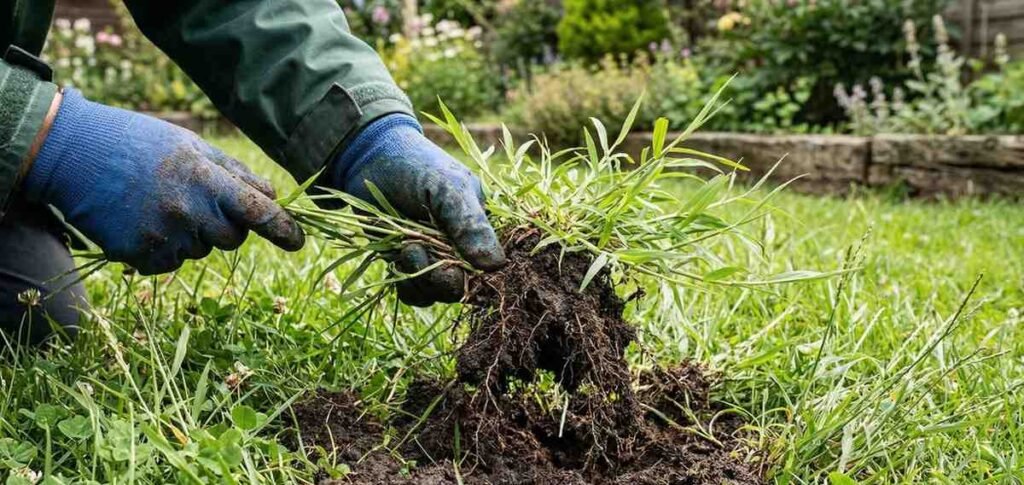
For small infestations or occasional pop-ups, the best tool is a long flat-head screwdriver or a dedicated weeding tool.
- Locate the center “crown” where all the stems meet.
- Insert the screwdriver into the soil at an angle right under the crown and pry up to loosen the root mass.
- Pull the entire plant out. If you do this before it seeds, you have successfully stopped 150,000 future weeds.
Lawn Repair – Healing the Wounds
When a large Crab grass plant dies in the winter, it leaves behind a “dead zone”—a patch of bare dirt. If you don’t fill that hole with good seed, nature will fill it with a new weed next spring.
Spring vs. Fall Seeding
While we are discussing springtime care, Fall is actually the undisputed best time to repair lawn damage through overseeding. However, if you have large bare spots in the spring that you must fix:
- Rake away the dead crabgrass debris to expose dirt.
- Scuff the soil surface.
- Apply high-quality grass seed.
- Crucial Step: Do NOT use a standard pre-emergent, as it will kill your new grass seed. You must use a product containing Mesotrione (brand name Tenacity). This is the only chemical designed to allow new grass seed to grow while still blocking weed germination.
Crab Grass in the 2026 Climate
As weather patterns shift, the “Crab grass season” is getting longer in many hardiness zones. We are seeing stronger “second waves” of germination in late July due to hotter summers.
The Role of Technology
Smart irrigation controllers (like Rachio or Wyze) are becoming essential tools. They use hyper-local weather data to prevent watering when rain is forecast. By preventing chronic “over-watering” during humid, hot weeks, these systems reduce the soggy environment that crabgrass thrives in over established turf.
Frequently Asked Questions
Q: Can I just mow the seed heads off to stop it spreading?
A: It helps reduce the seed bank, but it won’t kill the current plant. Crabgrass is highly adaptive; if you mow it short, it will simply start producing seed heads almost flat against the ground, beneath the mower blades.
Q: Will mulch stop crabgrass in my garden beds?
A: Yes, absolutely. A 3-inch layer of hardwood or cedar mulch is the best defense in garden beds, as it completely blocks the light required for germination.
Q: Why did I get crabgrass even though I used a pre-emergent?
A: Common reasons include: applying it too early (it wore off), applying it too late (seeds already sprouted), failing to water it in, or raking/aerating the lawn after application and breaking the chemical barrier.
Conclusion: Consistency is Key
The war against Crab grass isn’t won in a single Saturday afternoon. It is a continuous cycle of good habits: mowing high, watering deep, and hitting that critical window of time in the spring for pre-emergent application.
If you follow these steps meticulously, you will see your weed population drop by 70–80% in the first year alone. By the third year of consistent care, your lawn will be so thick that the “Chestnut Monster” won’t even find a place to land.