
Black and White Snake Identification Guide: Species, Safety, and Ecology
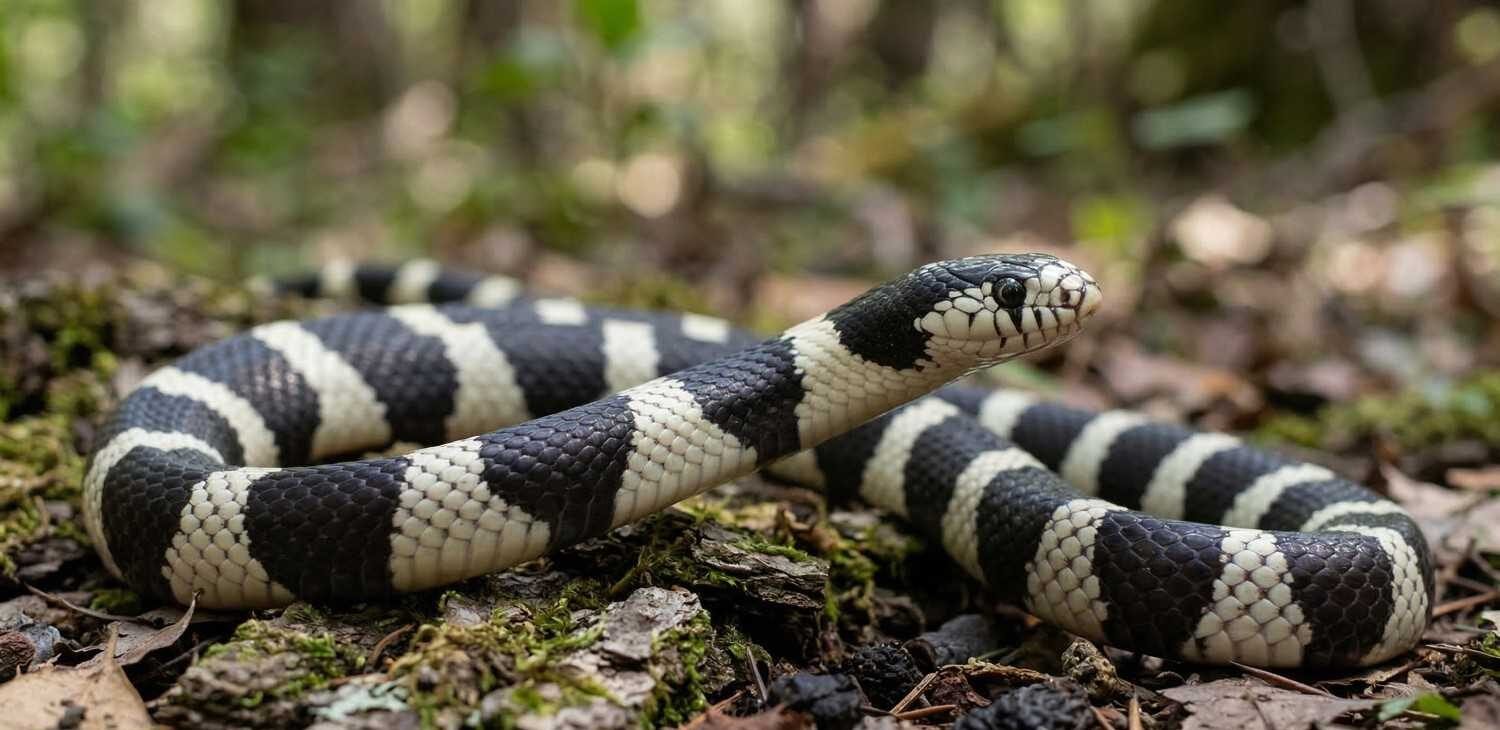
In the verdant tapestry of the natural world, few creatures command attention quite like the black and white snake. While nature often favors camouflage in greens and browns, the stark, high-contrast “tuxedo” pattern of these serpents is a biological statement. It is bold, graphic, and impossible to ignore.
For homeowners, hikers, and herpetology enthusiasts, the sight of a monochrome serpent often triggers an immediate dual response: fascination and fear. Is it a harmless garden helper, or is it a lethal threat? The answer is complex. The phrase “black and white snake” does not refer to a single species but constitutes a descriptive category covering dozens of distinct reptiles across the globe.
From the docile, rodent-eating California Kingsnake in the American West to the highly venomous Many-Banded Krait of Southeast Asia, these animals have evolved similar colorations for vastly different reasons. This comprehensive guide will serve as your ultimate resource for identifying these snakes, understanding their behavior, and appreciating the evolutionary ecology behind their striking appearance.
The Science of Snake Identification
Identifying a snake is a process of elimination. Relying solely on color is the most common pitfall for amateurs. A “black and white snake” could be one of fifty species depending on where you are standing. To make an accurate identification, you must look beyond the colors and analyze the architecture of the pattern and the texture of the anatomy.
1. Decoding the Pattern Architecture
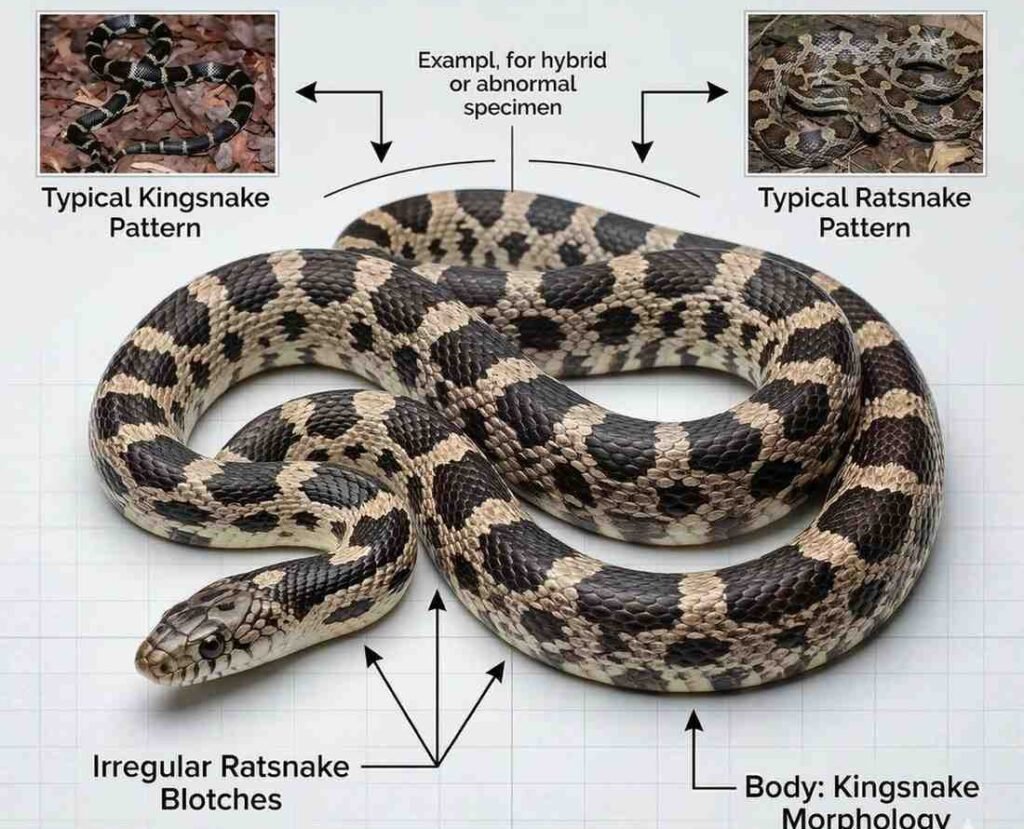
The way the black and white pigments interact on the snake’s body is your primary diagnostic tool. Snakes generally fall into specific pattern categories.
The Four Main Pattern Types:
- Banded/Ringed: The snake has distinct rings that encircle the body or “saddles” that sit on top but stop at the belly. This is common in Kingsnakes and Kraits.
- Longitudinal Striped: Distinct lines running from head to tail. While common in Garter snakes, some black and white morphs utilize this to confuse predators.
- Blotched: Irregular patches of black on a white or grey background. This is the hallmark of the juvenile Ratsnake.
- Speckled: A “salt and pepper” look where individual scales contain both pigments.
2. Texture: Smooth vs. Keeled Scales
If you can safely observe the snake (or have a high-quality photo), the texture of the scales is a definitive clue that separates entire families of snakes.
- Smooth Scales: These snakes appear glossy, wet, or polished like vinyl. They reflect light effortlessly. This texture is typical of Kingsnakes and Racers.
- Keeled Scales: These scales have a raised ridge running down the center of each scale, similar to the keel of a boat. This texture is typical of Ratsnakes, Hognose Snakes, and Vipers.
3. Geographical Context
Geography is the ultimate filter. A banded snake found in California is almost certainly a Kingsnake. A visually similar snake found in a rice paddy in Taiwan is likely a Krait. Always map the snake to its location before consulting a field guide.
Common North American Species
North America is home to a robust population of non-venomous black and white snakes. These are often beneficial predators that play a crucial role in controlling rodent populations and maintaining ecosystem balance.
The Harmless Constrictors: Kingsnakes (Lampropeltis)
The Kingsnake is the most iconic black and white snake in the United States. They earn their name because they actively hunt and consume other snakes, including venomous Rattlesnakes and Copperheads. They are immune to pit viper venom, making them the top predator in their weight class.
California Kingsnake (Lampropeltis californiae)
- Range: Western United States (California, Arizona, Nevada, Oregon) and Baja California.
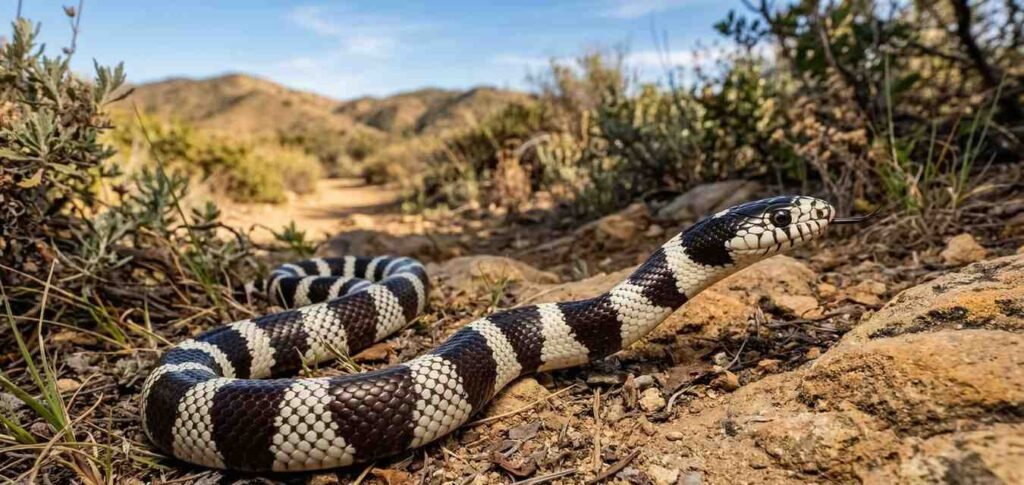
- Identification: This species is highly variable. The “Classic Morph” features distinct, alternating bands of dark black or chocolate brown and crisp white. The bands are usually uniform in width.
- The “Striped” Morph: In San Diego and coastal areas, you may encounter a Kingsnake that is black with a single white line running down its spine.
- Behavior: They are diurnal (active during the day) and generally docile, though they may musk or bite if handled roughly.
Eastern Kingsnake (Lampropeltis getula)
- Range: Eastern Seaboard from New Jersey to Florida, extending west to Alabama.
- Identification: Often called the “Chain Kingsnake,” this snake is glossy black with thin white or pale yellow crossbands. The pattern looks like a chain-link fence has been draped over the animal.
- Ecology: They prefer moisture and are often found near swamps, riverbanks, and pine forests.
Speckled Kingsnake (Lampropeltis holbrooki)
- Range: Central United States, centered on the Mississippi River Valley.
- Identification: The definitive “Salt and Pepper” snake. The ground color is black, but nearly every single scale has a white or yellow dot in the center. From a distance, they can look green or grey due to the optical blending of colors.
The Rodent Patrol: Ratsnakes (Pantherophis)
Ratsnakes are large, powerful constrictors that are frequently found near barns, silos, and suburban garages. They are excellent climbers and are often the culprit when a snake is found in an attic or birdhouse.
The Juvenile Confusion
One of the most common identification errors involves the Black Ratsnake.
- Adults: In the northern parts of their range, adult ratsnakes are almost solid black, sometimes with faint white patterns showing when the skin stretches.
- Juveniles: Young ratsnakes look nothing like the adults. They are pale grey or white with distinct black or dark brown blotches down their back.
- The Mistake: Homeowners often kill these harmless juveniles, mistaking them for Copperheads (which are brown/tan) or Rattlesnakes.
The Speedsters: North American Racers (Coluber constrictor)
- Identification: As their name implies, Racers are built for speed. They are slender, long, and have large eyes. Adults are a uniform, satiny black (both on the back and the belly), often with a patch of white on the chin.
- Behavior: Unlike the slow-moving Kingsnake, a Racer will flee instantly if approached. They are nervous, high-energy snakes that hunt by sight, often raising their heads like a periscope to scan the grass.
Venomous Black and White Snakes (The Danger Zone)
While the majority of black and white snakes in North America are harmless, there are significant exceptions globally and regionally. Misidentification here can have severe consequences.
1. The Many-Banded Krait (Bungarus multicinctus)
Native to China, Taiwan, and Southeast Asia, the Krait is one of the most venomous land snakes in existence.
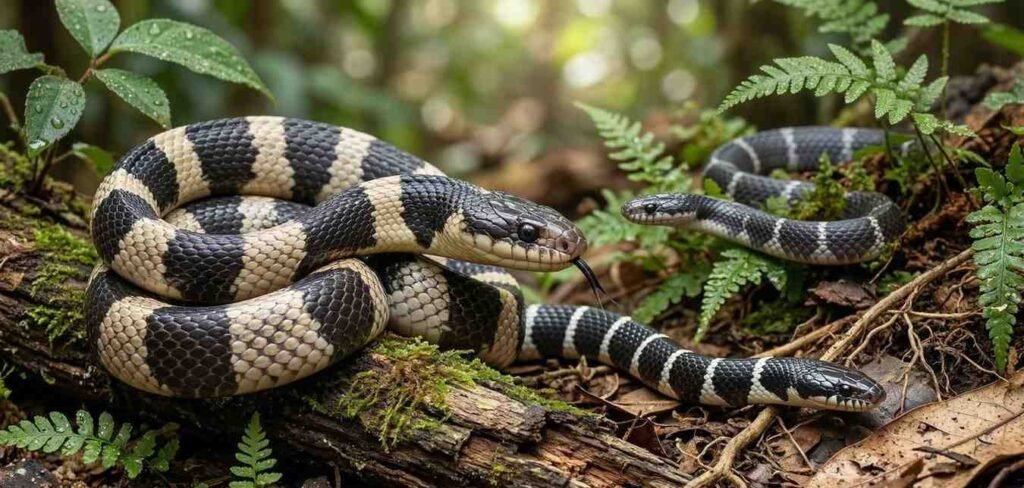
- Identification: The snake has alternating, very clean bands of black and white along its entire length. The scales are smooth and glossy. The body profile is triangular in cross-section.
- Behavior: Kraits are nocturnal. They are often docile during the day but become active and dangerous at night.
- Venom: Their venom is a potent neurotoxin. Bites are often painless initially, leading victims to delay treatment until respiratory paralysis sets in.
2. The Timber Rattlesnake “Black Phase” (Crotalus horridus)
Found in the Northeast and Appalachian regions of the US, the Timber Rattlesnake is a pit viper.
- Identification: While many Timber Rattlesnakes are yellow or brown, the “black phase” morph is common in mountainous areas. These snakes have a velvet-black head and tail, with black chevron markings over a dark grey body.
- Distinction: Look for the rattle at the end of the tail, the heavy, thick body, and the broad, arrow-shaped head. The scales are heavily keeled (rough).
3. The “Anerythristic” Coral Snake
The North American Coral Snake is famous for its red, yellow, and black bands (“Red touch yellow, kill a fellow”). However, rare genetic mutations (anerythrism) can remove the red pigment. This leaves a snake that is banded black and white (or pale yellow). While extremely rare, it serves as a reminder: Never touch a banded snake unless you are 100% certain of the ID.
The Ecology of Contrast – Why Be Black and White?
From an evolutionary standpoint, coloration is expensive. Producing pigment requires metabolic energy. Why would an animal evolve such a high-contrast pattern that seems to stand out against a green forest floor or brown soil? There are three primary ecological theories explaining this “tuxedo” phenotype.
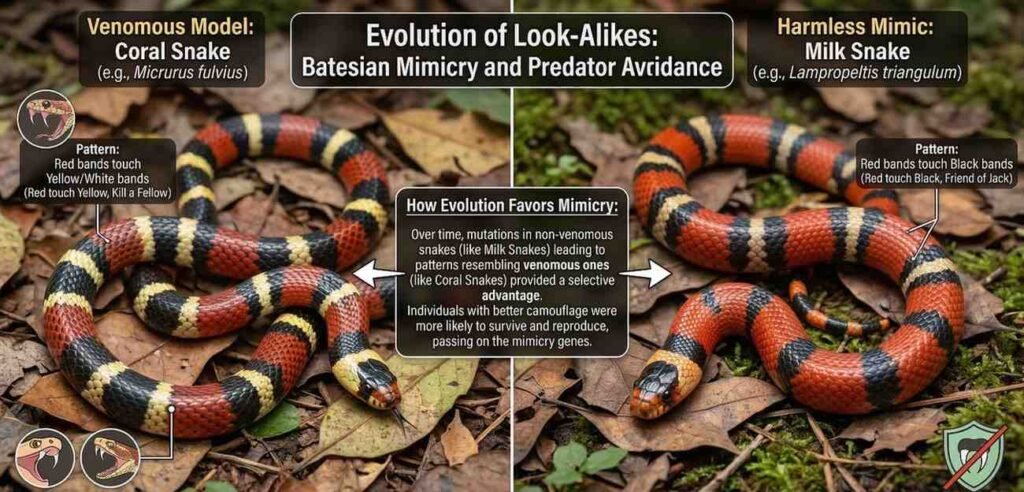
1. Batesian Mimicry: The Biological Bluff
Some non-venomous snakes have evolved to look like venomous ones. This is known as Batesian Mimicry.
- The Mechanism: Predators (like hawks, foxes, and badgers) learn to avoid dangerous prey. If a venomous snake has a bold black and white banded pattern (like a Krait), a harmless snake that evolves a similar pattern gains “protection by association.”
- The Example: The harmless Milk Snake or Kingsnake often mimics the banding of Coral Snakes. Even though the pattern isn’t identical, it is close enough to make a predator hesitate—and that hesitation allows the snake to escape.
2. Disruptive Coloration: Hiding in Plain Sight
It seems counterintuitive, but black and white can be excellent camouflage in high-contrast environments.
- The Environment: In a forest, sunlight filters through the leaves, creating a chaotic floor of bright sunspots and deep shadows.
- The Effect: A solid-colored snake has a recognizable outline. A snake broken into patches of black and white loses its outline. The “edges” of the animal disappear into the background noise of the light and shadow. A predator looking for the shape of a snake looks right past the pattern of the snake.
3. Flicker Fusion: The Optical Illusion
This strategy is utilized by fast-moving banded or striped snakes (like the California Kingsnake or Ribbon Snake).
- The Mechanism: When a banded snake moves rapidly, the high-contrast bands blur together visually. This phenomenon is called “Flicker Fusion.”
- The Result: It becomes difficult for a predator to determine the speed of the snake or exactly where the body is. A bird pecking at the snake might misjudge the lead and strike the tail or miss entirely, allowing the snake to survive.
Coexisting with Black and White Snakes
If you find a black and white snake in your garden, garage, or hiking trail, your reaction should be one of caution and respect, not aggression.
The “Leave It Be” Policy
The vast majority of snakebites occur when humans try to kill or capture the snake. If you leave the snake alone, it poses zero threat to you.
Identification Steps for Safety
- Stop: Freezing movement allows the snake to feel safe and usually stop moving, giving you a chance to look.
- Distance: Maintain a distance of at least 6 feet (2 meters). This is outside the strike range of almost any snake you will encounter.
- Photograph: Use the digital zoom on your phone to take a picture. Focus on the head and the pattern on the back.
- Verify: Upload the photo to a local herpetology group or use an identification app like iNaturalist.
The Value of Yard Snakes
Having a Kingsnake or Ratsnake on your property is often a blessing.
- Pest Control: A single Ratsnake can consume dozens of rodents in a season, reducing the risk of hantavirus, lyme disease (carried by ticks on mice), and property damage from chewing.
- Snake Control: Kingsnakes actively hunt venomous snakes. If you have a resident Kingsnake, you are far less likely to have Rattlesnakes or Copperheads nearby.
Conclusion
The world of black and white snakes is a testament to the diversity of reptilian evolution. These animals have utilized the starkest colors in the spectrum to warn predators, confuse attackers, and hide in plain sight. Whether it is the harmless, beneficial Ratsnake keeping your barn free of mice, or the reclusive Krait patrolling the Asian night, these monochrome serpents are vital components of their ecosystems. By understanding their patterns and respecting their space, we can coexist safely with these beautiful and misunderstood creatures.