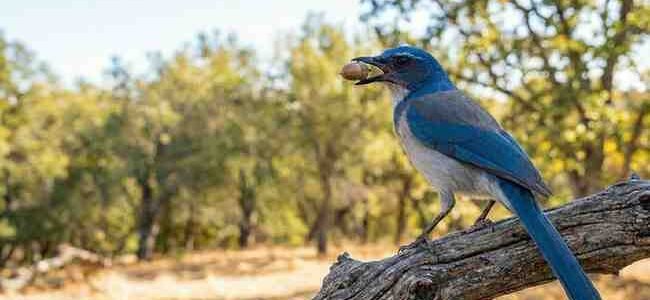
The California Jay Bird: A Complete Guide to the California Scrub-Jay
If you live in the Western United States, particularly along the Pacific Coast, you have likely encountered a flash of electric blue swooping through your garden, accompanied by a raspy, confident shriek. This is the California Scrub-Jay (Aphelocoma californica), a bird often mistakenly called a “Blue Jay” but possessing a personality and intellect entirely its own.
While they may lack the crested head of their eastern cousins, these corvids are among the smartest animals on the planet. From planting oak forests to remembering the exact timestamp of a hidden peanut, the California Scrub-Jay is a marvel of evolutionary biology. This bird is not just a backyard visitor; it is a dominant force in its ecosystem and a fascinating subject for behavioral observation.
This comprehensive guide covers everything you need to know about the “California Jay,” including its complex taxonomy, how to distinguish it from look-alikes, its shocking intelligence, and expert tips on attracting them to your backyard.
1. “California Jay” vs. “Blue Jay”: Clearing the Confusion
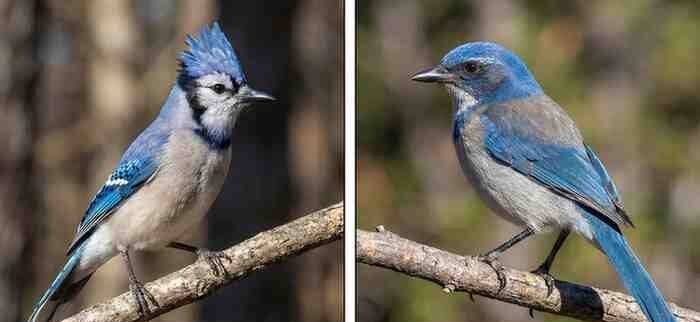
One of the most common search queries regarding this bird stems from a case of mistaken identity. It is crucial for accurate identification to clarify the names immediately. Colloquially, many residents call them “California Jays” or simply “Blue Jays.” However, the true Blue Jay (Cyanocitta cristata) is a completely different species found primarily east of the Rocky Mountains.
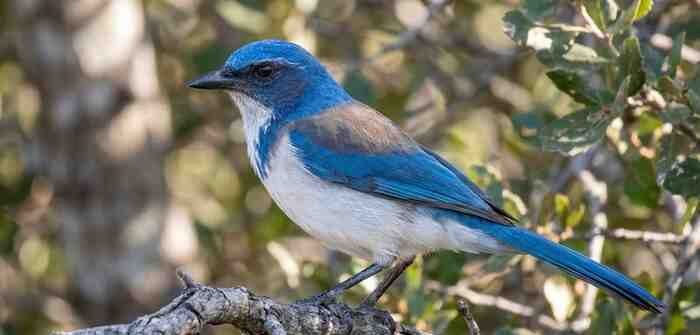
The easiest way to tell the difference is by looking at the head. The eastern Blue Jay has a prominent crest—a mohawk of feathers that it can raise or lower. The California Scrub-Jay is entirely crestless, possessing a smooth, round head. Furthermore, until 2016, this bird was grouped with the Woodhouse’s Scrub-Jay under the umbrella name “Western Scrub-Jay.” The American Ornithological Society officially split the species based on genetic and habitat differences, giving the coastal birds their own distinct status as California Scrub-Jays.
Quick Identification Checklist
If you see a blue bird in California or Oregon, check for these specific traits to confirm it is a California Scrub-Jay:
- Head Shape: Deep azure blue, round, and entirely smooth (no crest).
- Back Color: A distinct patch of brownish-gray in the center of its back (often called a “saddle”).
- Chest and Throat: White underparts with a distinct blue “necklace” or breast band streaking across the upper chest.
- Eyebrow: A faint white line just above the eye (supercilium), giving it a somewhat fierce expression.
- Behavior: Bold and assertive, often seen hopping on the ground in search of food or perching conspicuously on fence posts and rooftops.
2. Habitat and Distribution: Where They Thrive
The California Scrub-Jay is true to its name, thriving in the unique scrub habitats that define much of the West Coast landscape. Their range is relatively narrow but long, stretching from southern British Columbia down through Washington, Oregon, and California, extending all the way into Baja California, Mexico.
Unlike many colorful birds that migrate south for the winter, the California Scrub-Jay is a year-round resident. They are non-migratory, meaning the bird you see in your yard in July is very likely the same individual you see in January. They establish permanent territories that they defend vigorously against intruders throughout the seasons.
Their preferred ecosystems are tightly linked to their food sources. They are most abundant in oak woodlands and chaparral—dense, shrubby environments that offer both abundant acorns and cover from aerial predators like hawks. However, they have proven highly adaptable to human encroachment. Suburban gardens with mature trees and dense hedges often mimic their natural habitat well enough that they readily move into neighborhoods, especially where bird feeders provide a steady supplementary food source.
3. The Einstein of the Bird World: Intelligence & Memory
The most fascinating aspect of the California Scrub-Jay is its brain. As a member of the Corvid family—which includes crows, ravens, and magpies—they possess cognitive abilities that rival great apes and dolphins. Their intelligence is largely driven by the necessity of surviving harsh winters by relying on hidden food stores.
Episodic-Like Memory
In a landmark 1998 study by researchers Nicola Clayton and Anthony Dickinson, California Scrub-Jays changed our entire understanding of animal intelligence. The study demonstrated that these jays possess “episodic-like memory.” Previously, it was thought only humans could mentally travel back in time to remember specific past events.
In the experiment, jays were given perishable food (waxworms) and non-perishable food (peanuts) to hide. If the jays were allowed to recover the food after a short time, they went for the tasty waxworms. If a long time had passed, they ignored the waxworms—knowing they would have rotted by now—and went straight for the peanuts. This implies they do not just remember where they put things; they remember what they put there and exactly when they did it.
The “Thief’s Guilt” and Theory of Mind
California Scrub-Jays are rampant thieves. They will watch other jays hide acorns and then steal them later when the coast is clear. Interestingly, researchers found that jays who have stolen food in the past are more paranoid about their own caches.
If a “thief” jay notices another bird watching it hide a nut, it will wait for the observer to leave and then immediately dig up the nut and move it to a new, secret location. Innocent jays (who have never stolen) rarely do this re-caching behavior. This suggests a rudimentary “Theory of Mind”—the ability to understand that another being has its own perspective and intentions (in this case, the intention to steal).
4. Diet and The Great Oak Planters
While they will happily eat bread or chips if offered (though you shouldn’t feed them these), their ecological role is defined by the acorn. The relationship between the California Scrub-Jay and oak trees is mutualistic; the oaks provide food, and the jays provide dispersal.
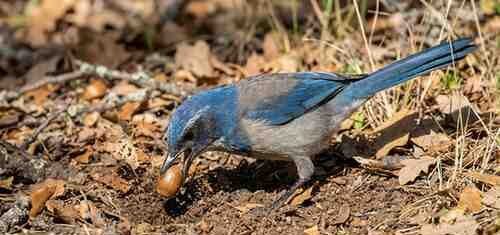
A single California Scrub-Jay can hide (cache) up to 5,000 acorns in a single autumn. They meticulously bury them one by one in the ground to save for winter when other food sources are scarce. They use landmarks to create a mental map of thousands of individual hiding spots.
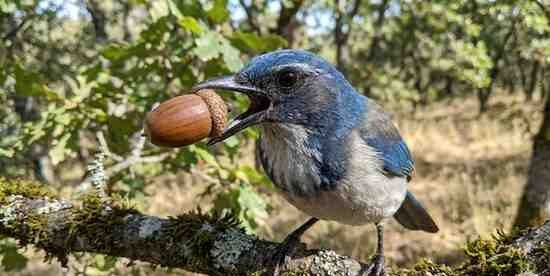
However, while their memory is incredible, they do not recover 100% of their caches. Some jays die, and some acorns are simply forgotten. The acorns left in the ground often germinate in the spring. It is estimated that Scrub-Jays are responsible for replanting thousands of oak trees across California every year. They essentially farm the very forest that sustains them, planting oaks far uphill from the parent trees where gravity wouldn’t take them.
Their diet is omnivorous and seasonal. In spring and summer, they focus on protein: insects, lizards, frogs, and unfortunately, the eggs and nestlings of smaller birds. In fall and winter, their diet shifts almost exclusively to acorns, nuts, seeds, and berries.
5. How to Attract California Scrub-Jays to Your Yard
If you want to befriend these charismatic birds, it is surprisingly easy. Because they are naturally bold and highly food-motivated, they can be trained to trust humans relatively quickly.
The Ultimate Lure: Peanuts in the Shell
While they will eat sunflower seeds and suet, the absolute best way to attract a California Scrub-Jay is whole, raw, unsalted peanuts in the shell. The shell is key. They enjoy the challenge of cracking it open, which mimics their natural behavior of hammering open acorns.
To attract them initially, try shaking a bag of peanuts outside. Their curiosity is easily piqued by unusual sounds, and they will investigate. Once they realize you are the source of the high-value food, they will become regular visitors. They have excellent internal clocks; if you establish a routine of putting peanuts out at 8:00 AM every morning, they will eventually be waiting on your fence before you even step outside.
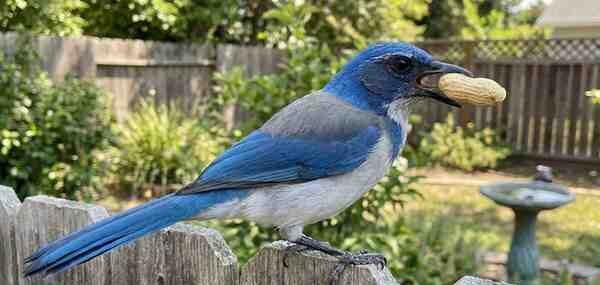
Feeder Recommendations and Hand Feeding
These are relatively large birds (about 11-12 inches long) and often struggle to balance on small tube feeders designed for finches. An open platform feeder, a large tray feeder, or simply placing nuts on a deck railing works best. They also love to bathe, so a shallow, reliable birdbath with fresh water will attract them daily for splashing and drinking.
With patience, California Scrub-Jays can be trained to eat from your hand. Start by placing peanuts on a table near you while you sit quietly. Over several days, move the peanut closer. Eventually, hold the peanut flat in your open palm, keeping your hand steady. The jay will likely swoop down, assess the situation, grab the nut, and fly off immediately.
⚠️ Important Warning: Do not feed them salted nuts, seasoned nuts, or bread. Salt is toxic to birds in high quantities, and bread offers zero nutritional value, filling them up without providing the energy they need.
6. Behavior and Social Structure
Unlike the highly social American Crow that roosts in massive communal flocks numbering in the thousands, Scrub-Jays are more territorial and family-oriented. They typically form long-term monogamous pair bonds and defend their territory together.
They build sturdy basket nests low in trees or dense shrubs, usually 6 to 15 feet off the ground, well-hidden from predators. The female incubates the eggs while the male brings her food.
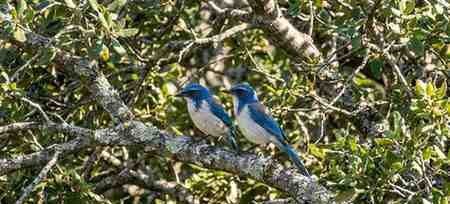
One of their most peculiar behaviors is the “Jay Funeral.” If a California Scrub-Jay discovers a dead jay, it will not ignore it. Instead, it will land near the body and emit loud, raucous, screeching calls. This attracts other jays in the vicinity, who join in a cacophonous gathering around the deceased bird. Researchers believe this behavior is not “mourning” in the human sense, but rather a way for the community to communicate danger, identify the location where a predator might be active, and learn about local threats.
7. Conservation Status
Currently, the California Scrub-Jay is listed as a species of Least Concern by the IUCN. Their adaptability to suburban environments has allowed them to thrive in areas where more sensitive species have vanished.
However, they are not immune to threats. Like all corvids, they are disproportionately affected by West Nile Virus, a mosquito-borne illness that can decimate local populations. Furthermore, continued habitat loss—specifically the destruction of native oak woodlands for agriculture and housing developments—poses a long-term threat to their natural food supply and nesting grounds.
Conclusion
The California Scrub-Jay is more than just a splash of blue color in the western landscape; it is a creature of immense intellect, complex social behavior, and vital ecological importance. Whether you call them “Blue Jays,” “California Jays,” or by their scientific name Aphelocoma californica, respecting them means understanding their role as the gardeners of the oak forests.
Next time you hear that raspy shreeonk call in your backyard, toss out a peanut. You might just make a friend who has the cognitive capacity to remember your face—and your generosity—for years to come.